


Participation rates in the organized colorectal cancer screening program, 2018–2019
The specifications for cancer screening programs published in the Official Journal on December 21, 2006 (Appendix to No. 295) stipulate that people aged 50 to 74 are encouraged to undergo colorectal cancer screening every two years. Participation rates, calculated for the 2018–2019 period for all French departments, are presented here, along with exclusion rates and positivity rates.
Materials and Methods
The method for calculating the indicators is based on the data format guide and definitions of indicators for the national program evaluation (see Data Format Guide). The indicators are thus calculated over a two-year period, during which the entire eligible population of a department is invited to participate in screening.
Test used for screening
Reminder: The guaiac fecal occult blood test (Hemoccult® II) was replaced by the immunological test (OC Sensor®) in April 2015.
Calculation of the participation rate
The participation rate is the ratio of the number of people screened to the eligible population, i.e., the program’s target population (men and women aged 50 to 74) from which those excluded from the program for medical reasons are subtracted.
The number of people screened—that is, the number of men and women aged 50 to 74 who underwent a screening test during the evaluation period (here, from January 1, 2018, to December 31, 2019)—and the average number of people excluded from the program for medical reasons are provided by the CRCDC. The definition of medical exclusions is specified in the specifications.
The eligible population is obtained by calculating the arithmetic mean of the target population (based on INSEE’s Localized Population Estimates), from which the average number of people aged 50–74 excluded from the program for medical reasons during the two calendar years (2018 and 2019) must be subtracted.
Calculation of the exclusion rate
The exclusion rate is the ratio of the number of people excluded (temporarily or permanently) from the organized colorectal cancer screening program to the program’s target population (see above).
The number of excluded individuals is provided by the CRCDCs based on various usable data sources (responses from invited individuals, records of colonoscopies reimbursed by primary health insurance funds, records of diagnostic and therapeutic procedures, standardized reports of colonoscopy results and anatomopathological examinations, etc.), but access to which varies by CRCDC.
Calculation of the positivity rate
The positivity rate is the ratio of the number of people with a positive screening test to the number of people with an analyzable test, that is, a test that could be read by the laboratory.
Age groups
Data are presented by five-year age group.
The 50–54 age group includes individuals who turned 50 during the year under review, even if they had not yet reached that age at the time of the invitation; the 70–74 age group includes individuals who had turned 75 by the time of screening, to account for the time it takes to complete the test for those invited at age 74.
Standardization of indicators
Participation, exclusion, and positivity rates are calculated by department, by region, and for France as a whole. They are standardized by age and sex using the 2009 French population as the reference population (INSEE projection 2007–2042, central scenario). This standardization allows, by applying the same age and sex structure (that of the 2009 French population) to different geographic units (departments or regions), for comparing results across these areas and analyzing trends over time for the various indicators studied.
European Standards
European standards recommend a participation rate of the target population of 45% or higher.
Results
Participation
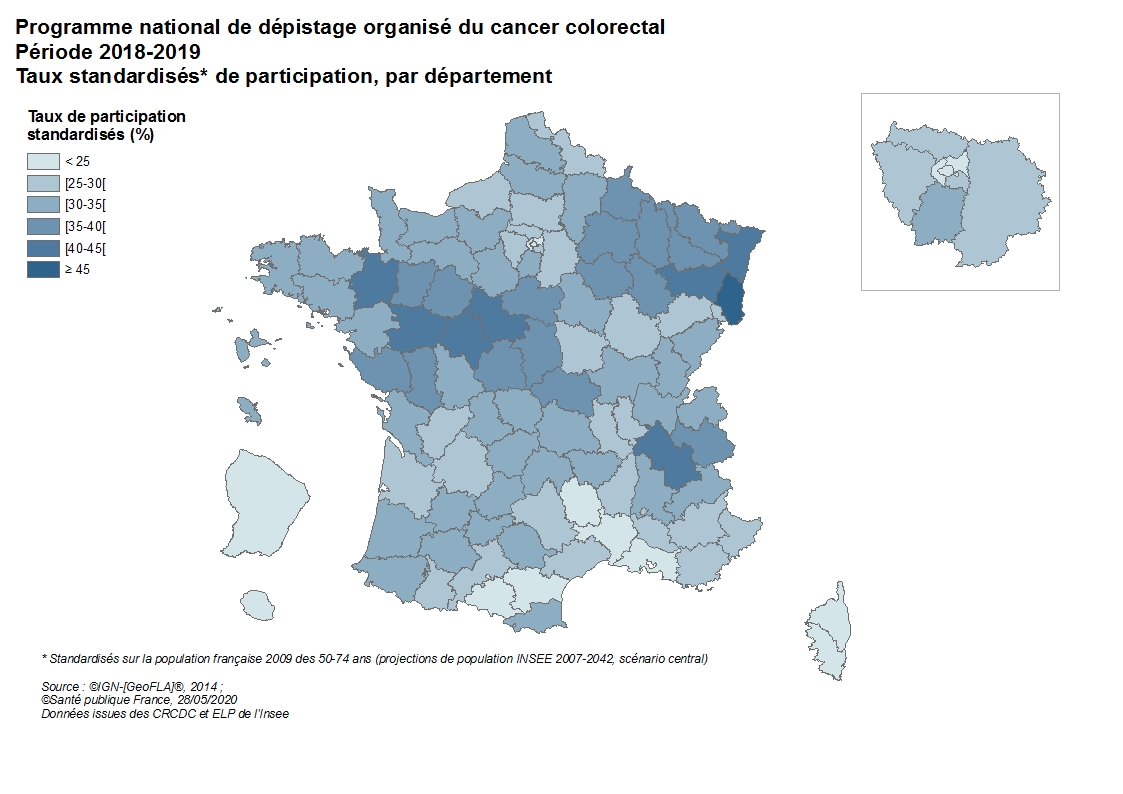
Over the period from January 1, 2018, to December 31, 2019, the target population for screening was estimated at over 20 million people. Nearly 5.3 million people underwent a screening test during the 2018–2019 period, representing a total participation rate of 30.5% (see tables in PDF and Excel formats). Contrary to expectations, participation rates did not increase with the switch to the more sensitive and easier-to-use immunoassay test. They even decreased compared to the 2017–2018 period (31.9%) and remain well below the minimum acceptable European target of 45% recommended by the European Commission.
The participation rate is higher among women (31.9%) than among men (29.1%) (see tables in PDF and Excel formats), and increases with age (see tables in PDF and Excel formats) (among men from 27.4% for those aged 50–54 to 34.1% for those aged 70–74, and among women from 29.6% for the youngest to 34.8% for the oldest). It varies by department. The lowest rates are observed in French Guiana (12.6%), Corsica (16.2%), and Paris (16.9%), and the highest in Ille-et-Vilaine (43.6%), Bas-Rhin (43.9%), and Haut-Rhin (45.1%).
Standardized participation rates
Exclusions
Medical exclusions must be reported regularly and as comprehensively as possible to ensure the quality of the program. They may be either permanent for medical reasons (personal or family history of adenomas or colorectal cancer, familial adenomatous polyposis, chronic inflammatory bowel disease, hereditary non-polyposis colorectal cancer, or Lynch syndrome), or temporary due to symptoms or because the individual has undergone a colonoscopy within the past five years with normal results.
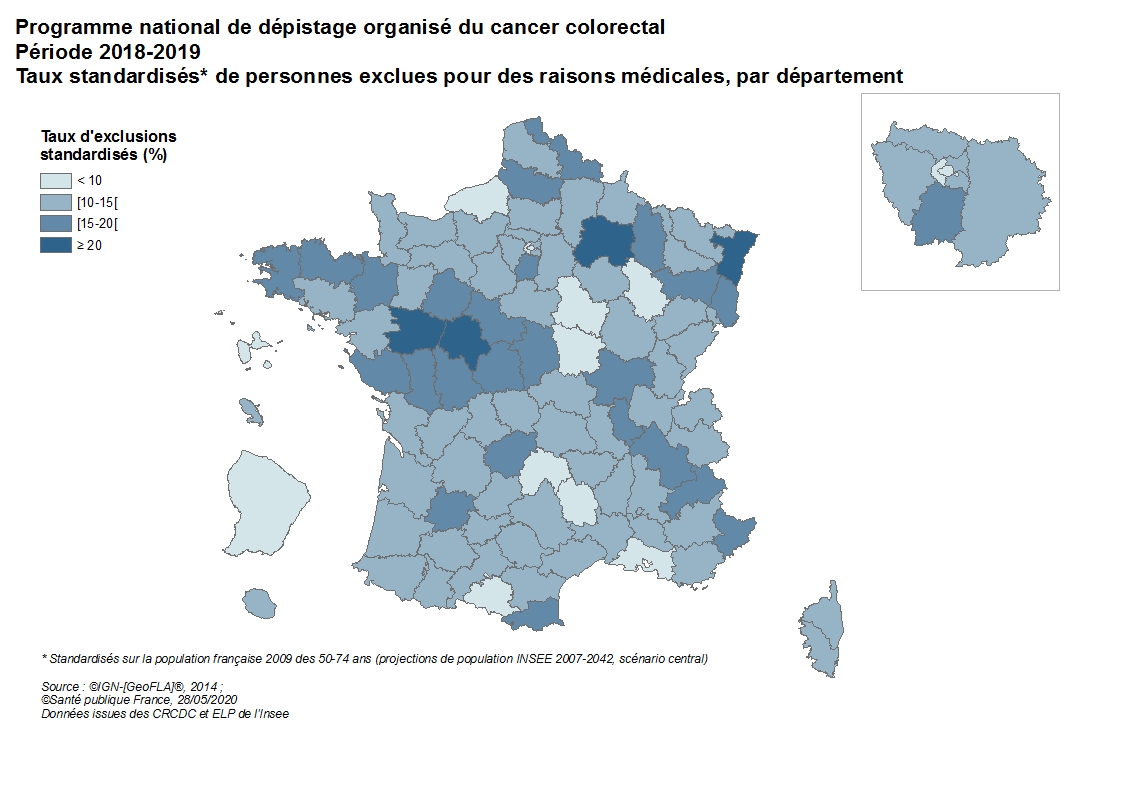
Over the 2018–2019 period, the exclusion rate was 13.3%, corresponding to 2.8 million people (see tables in PDF and Excel formats). This exclusion rate is broadly the same for men and women (see tables in PDF and Excel formats). It increases with age, rising among men from 6.0% for those aged 50–54 to 23.6% for those aged 70–74, and among women from 6.9% for the youngest to 20.4% for the oldest (see tables in PDF and Excel formats). This rate also varies by department. The lowest rates are observed in Bouches-du-Rhône (1.3%), Paris (5.9%), and Nièvre (8.4%), with the highest rates observed in Maine-et-Loire (22.8%), Indre-et-Loire (23.7%), and Bas-Rhin (23.8%) (see tables in PDF and Excel formats).
Standardized rates of individuals excluded for medical reasons
Positive test results
Note: The positivity threshold used is 30 µg of human hemoglobin per gram of stool (or 150 ng/ml in buffer), corresponding to an expected positivity rate in the French population of approximately 4%.
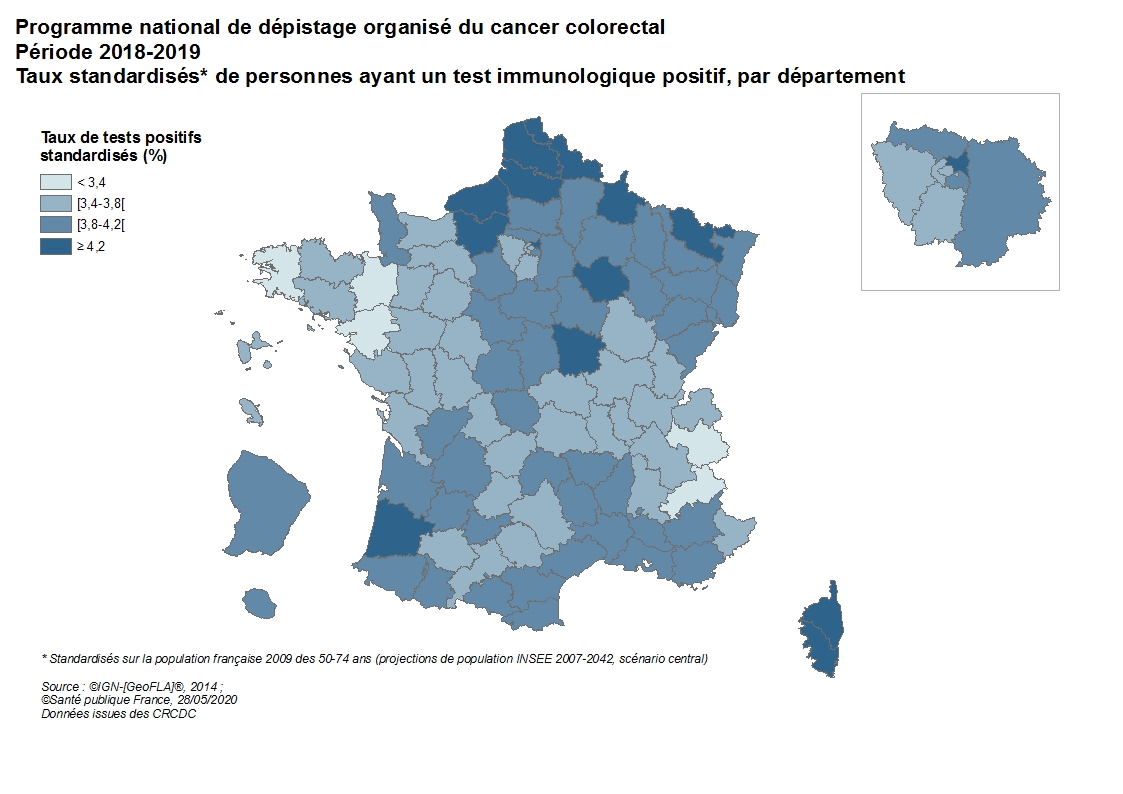
In total, over the 2018–2019 period, the screening test result was positive for 198,000 people, representing a positivity rate of 3.8% (see tables in PDF and Excel formats). This rate is higher among men (4.6%) than among women (3.1%). It increases with age (among men from 3.8% for those aged 50–54 to 6.1% for those aged 70–74, and among women from 2.7% for the youngest to 4.0% for the oldest). It also varies by department between 2.9% and 4.5% (see tables in PDF and Excel formats).
Standardized rates of people with a positive serological test
Conclusion
Between 2018 and 2019, 5.3 million people aged 50 to 74 underwent a screening test, representing a participation rate of 30.5%. The expected increase in participation following the switch to antigen testing has therefore not materialized so far. The participation rate remains well below the minimum acceptable European target of 45%. The rate of people with a positive antigen test result (3.8%) is in line with expectations.