



Sexually transmitted infections
Les infections sexuellement transmissibles (IST) se transmettent principalement lors des rapports sexuels. Il existe de nombreux virus ou bactéries transmissibles de cette manière.

Sexually Transmitted Infections: A Public Health Issue
Following HIV/AIDS prevention campaigns in the 1980s and early 1990s, the incidence of gonorrhea, syphilis, and other bacterial sexually transmitted infections (STIs) had dropped in several Western European countries, including France. The late 1990s and early 2000s saw a resurgence of STIs, as well as the reappearance of certain STIs that had previously been nearly eradicated in most Western countries, linked to a decline in the use of preventive measures.
Epidemiological Surveillance
Surveillance of bacterial STIs relies on several systems
SurCeGIDD surveillance: all Free Centers for Information, Screening, and Diagnosis of Human Immunodeficiency Virus Infections, Viral Hepatitis, and Sexually Transmitted Infections (CeGIDD) are legally required to participate in this surveillance, which covers the screening and diagnosis of HIV infection, viral hepatitis, syphilis, infections with Chlamydia trachomatis, Neisseria gonorrhoeae, and Mycoplasma genitalium, genital warts, and genital herpes (individual sociodemographic, behavioral, clinical, and biological data). They must submit anonymous individual data annually to Santé publique France.
Data from the National Health Data System (SNDS): Health insurance reimbursement data enable the monitoring of screening activity for Chlamydia trachomatis, syphilis, and gonorrhea conducted in private and public laboratories (excluding public sector hospitalizations). They also enable the monitoring of diagnoses of Chlamydia trachomatis, syphilis, and gonorrhea infections.
The survey on congenital syphilis based on data extracted (ICD-10 codes A500 to A509) from the Medical Information Systems Program (PMSI) database: this periodically repeated survey enables the estimation of the number of congenital syphilis diagnoses in children under 2 years of age at the national level.
Reporting of confirmed cases of congenital syphilis by the National Reference Center (CNR) for Bacterial STIs and other laboratories: This reporting contributes to the surveillance of congenital syphilis in children under 2 years of age.
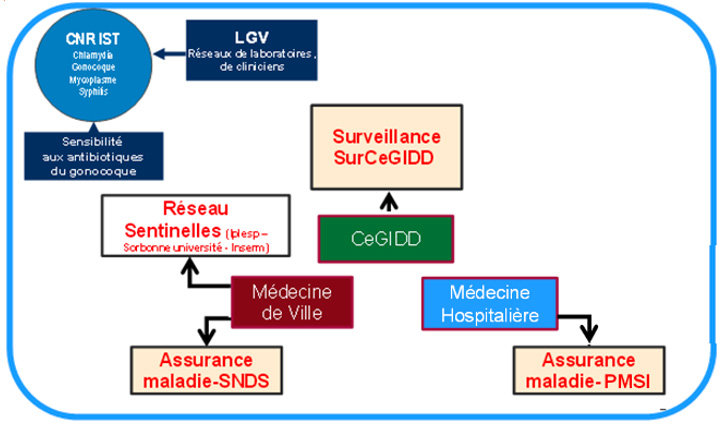
To monitor the epidemiological trends of sexually transmitted infections, Santé publique France collaborates with the National Reference Center for Bacterial STIs (Neisseria gonorrhoeae, Chlamydia trachomatis, Mycoplasma genitalium, and syphilis), which coordinates, among other things, the LGV network and the monitoring of antibiotic susceptibility in Neisseria gonorrhoeae and Mycoplasma genitalium.
The objective of epidemiological surveillance is to produce indicators that help identify the most at-risk populations and regions, in order to guide and evaluate prevention efforts within the framework of the national sexual health strategy.
Surveillance of HIV infection includes:
Surveillance of HIV testing activity, conducted using data from clinical laboratories (LaboVIH database) and data from the National Health Data System (SNDS). Also taken into account are the number of self-tests sold in pharmacies, rapid diagnostic tests (RDTs) conducted by CeGIDDs, and those conducted by authorized associations, the results of which are compiled by the DGS.
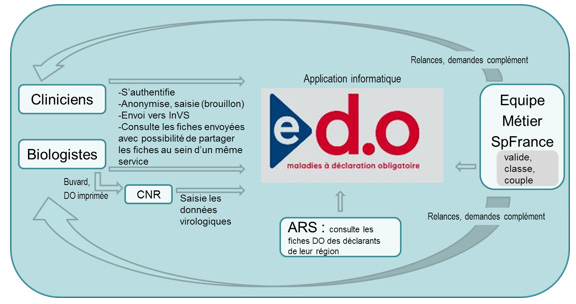
Data on newly diagnosed HIV-positive cases are available through mandatory reporting of HIV/AIDS, carried out by laboratory professionals and clinicians, who have been required to report the cases they diagnose via a web application—e-DO—since April 2016. AIDS diagnoses are also subject to mandatory reporting, carried out on e-DO by clinicians.
In addition to epidemiological surveillance of HIV, Santé publique France has implemented behavioral surveillance. Several survey programs targeting at-risk populations help improve our understanding of the dynamics of these infections, particularly with regard to sociodemographic factors, lifestyles, sexual histories, and risk behaviors. These surveys serve as decision-making tools for public health policy.
Combating sexually transmitted infections through prevention and screening strategies
The general public, as well as populations at highest risk for sexually transmitted infections—including young people and men who have sex with men—are the focus of targeted campaigns and informational websites aimed at raising awareness about screening and prevention, particularly through the consistent use of condoms during sexual intercourse.
Learn more:
Santé publique France develops prevention strategies tailored to different priority populations: the general public, young people, men who have sex with men (MSM), and migrants.
For bacterial STIs, condoms and testing are the current methods of prevention.
For HIV, other prevention strategies are also available; this is known as diversified prevention:
the consistent use of condoms during sexual intercourse;
testing, which allows for rapid access to treatment if an infection is diagnosed;
PrEP (meaning pre-exposure prophylaxis): antiretroviral treatment (continuous or on-demand) that significantly reduces the risk of HIV infection in HIV-negative individuals;
PEP (meaning post-exposure prophylaxis): antiretroviral treatment taken within hours of a risk exposure and for one month, which reduces the risk of HIV infection in HIV-negative individuals;
TasP (meaning Treatment as Prevention): the effect of continuous antiretroviral treatment that enables HIV-positive individuals to maintain an undetectable viral load and prevent transmission of HIV to sexual partners.

Chlamydia
thematic dossier
Chlamydia is a sexually transmitted infection caused by the bacterium Chlamydia trachomatis. The best ways to prevent transmission are to use condoms and get tested.

Gonorrhea
thematic dossier
On the rise between 2022 and 2024, and more common among men (particularly those aged 26–49) and young people, gonorrhea is a sexually transmitted infection caused by the gonococcus bacterium....

Hepatitis B and D
thematic dossier
Viral liver infections can be very severe; hepatitis B and D are transmitted through sexual contact, blood, and from mother to fetus. Vaccination and screening are the cornerstones of prevention.

HIV/AIDS
thematic dossier
HIV, or Human Immunodeficiency Virus, is a sexually transmitted human retrovirus. It weakens the immune system, and if left untreated, leads to AIDS.

Human papillomavirus infections
thematic dossier
Human papillomavirus (HPV) infection is a sexually transmitted infection caused by the human papillomavirus (HPV). The infection is usually asymptomatic and clears up within a few months. In some...

Syphilis
thematic dossier
Caused by the bacterium Treponema pallidum, syphilis is sexually transmitted. It can also be transmitted from mother to child during pregnancy. This disease can affect all organs and have serious...
Our latest news

news
Call for Nominations for the Renewal of the Scientific Advisory Board of the...

news
Growing Up with Screens. A special report in *La Santé en action* No. 474,...

news