

Breast Cancer Screening: What Was the Participation Rate Among Women in 2020?
Santé publique France has released new data on women’s participation in the organized breast cancer screening program. Every two years, this program invites women aged 50 to 74 to undergo a screening mammogram, supplemented by a clinical breast exam.

Breast cancer
thematic dossier
Breast cancer is the most common form of cancer in France and is the leading cause of cancer-related deaths among women. It is covered by a national screening program designed to detect the...
Breast cancer: early detection helps reduce mortality
Breast cancer is the most common cancer in France and is the leading cause of cancer death among women, with 12,146 deaths in 2018. It is the focus of a national organized screening program aimed at early detection and reducing mortality. Among the known risk factors for breast cancer, modifiable lifestyle factors have been identified, including alcohol consumption, smoking, overweight/obesity, and lack of physical activity.
In fact, in 2015, it is estimated that in mainland France, approximately 15.1% of breast cancers in women over 30 were attributable to alcohol consumption and 4.4% to smoking [Circ 2018]. According to the same study, 10.6% of postmenopausal breast cancers (women over 50) were attributable to overweight and obesity.
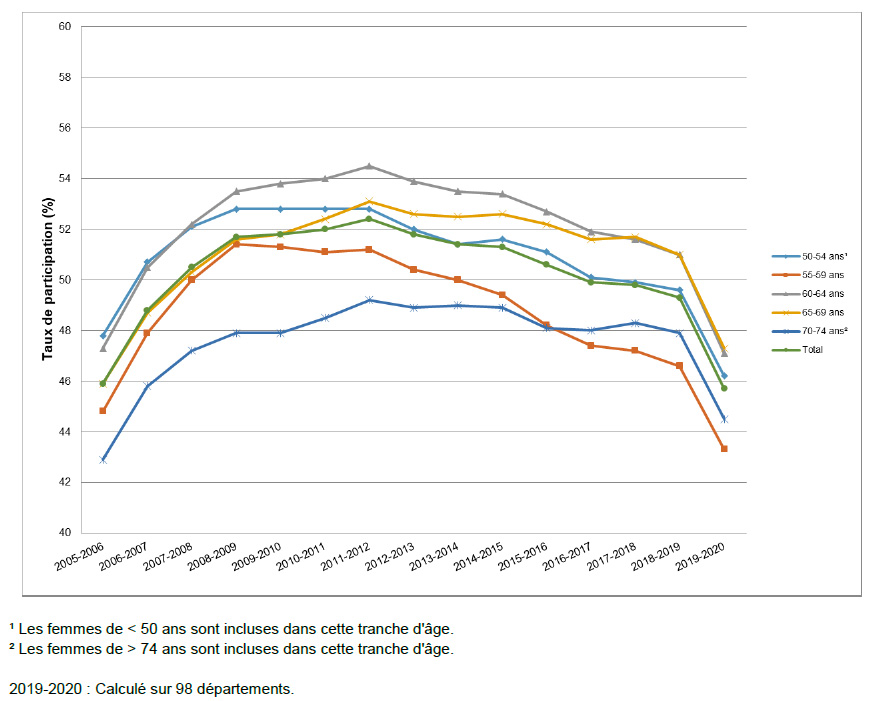
Participation in the screening program has been steadily declining for several years and saw a significant drop in 2020 due to the COVID-19 pandemic
In 2020, 2.5 million women underwent an organized screening mammogram, corresponding to a national participation rate of 42.8%. This represents a significant decline compared to previous years.
2.5
million women underwent an organized screening mammogram in 2020
This decline is observed across all age groups and in all regions of metropolitan France and in all DROMs. It is likely due to several factors related to the COVID-19 health crisis: the temporary closure of Regional Cancer Screening Coordination Centers during the first lockdown for varying durations depending on the region, leading to an interruption in the mailing of invitations and second-reading activities; the closure of radiology practices; and reduced activity upon reopening due to the implementation of necessary health measures, resulting in limited access to mammograms.
Trends in Participation Rates in Organized Breast Cancer Screening, by Age - 2005–2020
Monitoring indicators for women screened in 2017–2018 remain stable over time
To maximize benefits and minimize risks—that is, to be effective—an organized screening program must be of high quality and must be evaluated. The data presented correspond to the screening program’s performance indicators and provide information on the number of women screened, screening results, and diagnostic evaluations. These data are broken down by region and by department.
In 2017–2018,
5 million women underwent screening during the period, including:
4.1% were first-time screenings with no prior mammography history
12.6% were first-time screenings with a history of mammograms
83% were follow-up screenings
40,000 cancers were detected, or 7.6 cancers per 1,000 women screened
For every 100 cancers detected, 3 were detected through a second reading among women who underwent an initial screening, and 5.3 among those who underwent a follow-up screening
These results are in line with the recommended European benchmarks for most follow-up indicators.
Learn more about the follow-up indicators for screened women 2017–2018
Reducing risk factors through our prevention programs
Several resources accessible to everyone have been established by Santé publique France. Understanding health issues, reducing risks, changing behaviors… find all the information and tools in our dedicated resources and websites regarding:
smoking, particularly via the tabac-info-service.fr website
alcohol consumption, notably via the site alcool-info-service.fr
sedentary lifestyles and obesity, notably via the mangerbouger.fr website
What are Santé publique France’s responsibilities regarding the monitoring and evaluation of the organized breast cancer screening program?
participate in the epidemiological surveillance of breast cancer
Evaluating the performance of the national organized breast cancer screening program
Evaluate the impact of screening on breast cancer mortality and morbidity
promote efforts to combat preventable risk factors