

Cervical Cancer Screening: 2017–2019 Data
Santé publique France has released new data on cervical cancer screening coverage for the 2017–2019 period and, in partnership with INCa and the Haute Autorité de Santé, has developed a new clinical tool for cervical cancer screening intended for healthcare professionals.
Vaccination Information Service
What are vaccines for? How do they work? At what age should children be vaccinated? Vaccination-info-service.fr answers the most frequently asked questions about vaccination. A separate...
Eliminating cervical cancer: a public health priority
Each year, nearly 3,000 women develop cervical cancer, and 1,000 women die from it. Cervical cancer is preventable through two effective and complementary interventions: vaccination against the human papillomavirus (HPV) for primary prevention, and organized screening, combined with diagnostic confirmation and appropriate therapeutic management for secondary prevention.
As part of the Cancer Plan, the organized screening program aims to increase screening coverage to 80%, reduce inequalities in access to screening, and reduce the incidence and mortality from cervical cancer by 30% over a 10-year period.
Key Statistics on Cervical Cancer
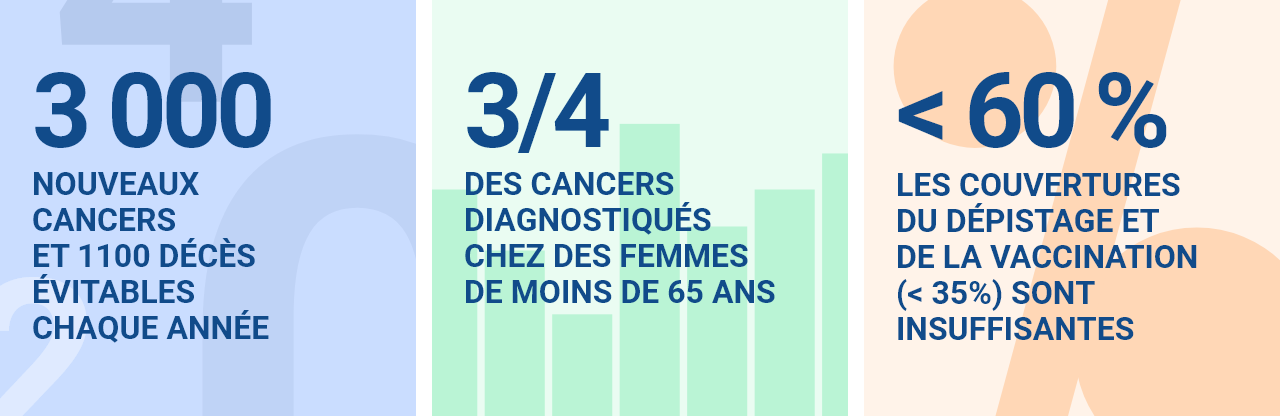
58.2% of women aged 25–65 underwent screening, a figure that has declined slightly
Santé publique France has published an update on national and subnational estimates of coverage for triennial cervical cancer screening. This update shows that national coverage for all women aged 25 to 65 is 58.2% for the 2017–2019 period, representing a slight decrease compared to coverage for previous rolling three-year periods since 2012 (59.5% for 2016–2018).
The slight decrease observed at the national level for the 2017–2019 period compared to previous three-year periods is seen across all age groups and in most regions. This could be due to the impact of the first lockdown related to the COVID-19 pandemic on cervical cancer screening uptake. In fact, three-year screening coverage is calculated in practice over a 3-year period plus an additional 6 months to account for the impact of the invitation system on coverage (i.e., from January 1, 2017, to June 30, 2020, for the 2017–2019 three-year period). However, this potential impact of the lockdown on cervical cancer screening uptake will need to be confirmed.
Key findings on cervical cancer screening for 2017–2019
National coverage for cervical cancer screening among all eligible women (ages 25–65) is 58.2%, representing a slight decrease compared to coverage in previous rolling three-year periods since 2012 (e.g., 59.5% for 2016–2018).
The differences in coverage by age and geographic region observed previously are confirmed. Coverage decreases significantly with age starting at age 50, falling to 43.9% among women aged 60–65.
There are marked geographical differences, with departmental rates ranging from 38.7% (French Guiana) to 68.1% (Bas-Rhin).
Coverage is particularly low (<45%) in the overseas departments and regions, with the exception of Réunion, as well as in Seine-Saint-Denis.
The highest coverage rates (>65%) are found in Haute-Garonne, the Rhône, Haut-Rhin, and Bas-Rhin, with the latter two departments being the metropolitan departments where an organized screening program has been in place for 20 to 30 years.
The slight decrease observed at the national level for the 2017–2019 period compared to previous three-year periods is seen across all age groups and in most regions.
These coverage data serve as a baseline prior to the full rollout of the national organized cervical cancer screening program across the entire country, providing Regional Health Agencies (ARS) and Regional Cancer Screening Coordination Centers (CRCDC) with a starting point for achieving the program’s 80% coverage rate target. These data can also help identify regions where specific efforts are needed. These estimates, broken down by region, department, and age group, are presented in the form of maps and tables on Géodes.
A new practical tool for cervical cancer screening intended for healthcare professionals

Santé publique France, in partnership with INCa and the Haute Autorité de Santé, has developed a tool for healthcare professionals that summarizes the practical aspects of screening and the recommended procedures based on a woman’s age, which have been updated in line with the latest recommendations from the Haute Autorité de Santé on cervical cancer screening. This tool is available on the INCa website.
Learn more: Cervical Cancer Screening in Practice
HPV vaccination to prevent cervical cancer
HPV vaccination is offered to girls and boys starting at age 11 to prevent cancers linked to HPV infections (cervical cancer, anal cancer, etc.), as well as genital warts, which are benign but difficult to treat. It is administered to young people because its effectiveness in preventing HPV infections is nearly 100% at that age. To date, more than 100 million children and adolescents have been vaccinated worldwide: the vaccine is very well tolerated, and a decline in cancerous or precancerous lesions is already being observed in countries with high vaccination coverage. Doctors, midwives (for girls), and nurses (with a doctor’s prescription) can administer the vaccine.
Vaccination-info-service: the vaccination information website
The vaccination-info-service.fr website is a leading resource on vaccination for the general public and healthcare professionals. It provides factual, practical, and scientifically validated information to answer various types of questions (searching for information by profile, about a specific disease, about vaccination in general, or about a particular vaccine, etc.). People are encouraged to review their vaccination status and consult their doctor for more information regarding their specific situation. A section dedicated to vaccination against human papillomavirus (HPV) infections is available in two separate sections: one for the general public and the other for healthcare professionals, to better support them in their practice.
See also:
Upcoming change to the screening coverage indicator in line with new HAS recommendations
The coverage indicator used to date is the “coverage rate for triennial cervical cancer screening among women aged 25–65.” This period corresponds to the recommended interval between two screenings via cytological examination (“Pap smear”).
Eventually, the cervical cancer screening coverage indicator will be modified to reflect the latest recommendations from the French National Authority for Health (HAS), which change the screening test used and the screening frequency based on women’s age:
cytology every 3 years for women aged 25–29;
HPV testing every 5 years for women aged 30 to 65.
These recommendations were officially incorporated into the national organized screening program in 2020 with the publication of new program guidelines.
Santé publique France’s initiatives regarding cervical cancer
Monitoring epidemiological trends in cervical cancer
Evaluating the national organized cervical cancer screening program
Monitoring vaccination coverage for human papillomavirus (HPV) infections

Cervical cancer
thematic dossier
Cervical cancer, which is caused in nearly 100% of cases by a sexually transmitted human papillomavirus infection, can be prevented through HPV vaccination and screening.

Human papillomavirus infections
thematic dossier
Human papillomavirus (HPV) infection is a sexually transmitted infection caused by the human papillomavirus (HPV). The infection is usually asymptomatic and clears up within a few months. In some...
Odysseus
Santé publique France's open data portal, based on its 70 surveillance systems, surveys, and scientific expertise.