


Colorectal Cancer: Screening Data for 2019–2020
Santé publique France has released data on colorectal cancer screening in France for the 2019–2020 period, showing that participation rates in the screening program continue to decline slowly.

Colorectal cancer
thematic dossier
Find the latest news and key information about colorectal cancer here.
Colorectal Cancer: A Preventable Cancer
Colorectal cancer develops from the cells that line the inner wall of the colon or rectum. Most often, these malignant tumors originate from a benign tumor that grows slowly and eventually becomes cancerous.
Colorectal cancer can be detected at an early stage through screening for occult blood in the stool. An organized screening program is offered in France to everyone aged 50 to 74. Those who test positive are invited to undergo a colonoscopy to detect the possible presence of precancerous lesions or cancer.
Several modifiable lifestyle-related risk factors (alcohol consumption, smoking, a sedentary lifestyle, physical inactivity, overweight and obesity, and a diet low in fiber and high in red meat or processed meats) have been identified, and these cancers are therefore partly preventable.
Key Statistics on Colorectal Cancer
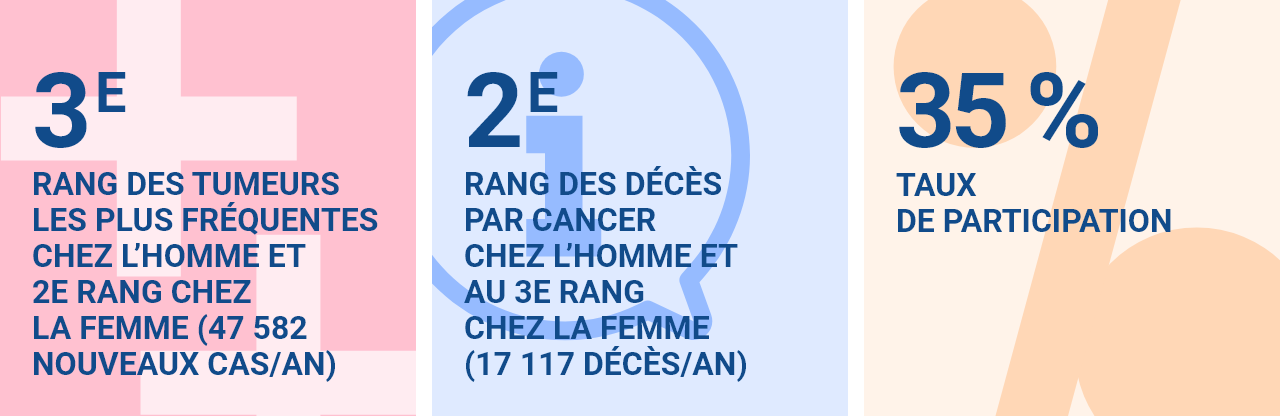
Nearly 29% of the population underwent colorectal cancer screening in 2019–2020, a figure that has been steadily declining for several years
5.1 million people underwent a colorectal cancer screening test (positive, negative, or unanalysable) in 2019–2020, representing a participation rate of 28.9% (compared to 30.5% in 2018–2019). Participation in the organized colorectal cancer screening program, which has been steadily declining since 2016–2017, continues to decrease slowly. Despite a temporary reduction in screening activities during 2020 due to the COVID-19 pandemic, no sharp drop in participation in this program was observed.
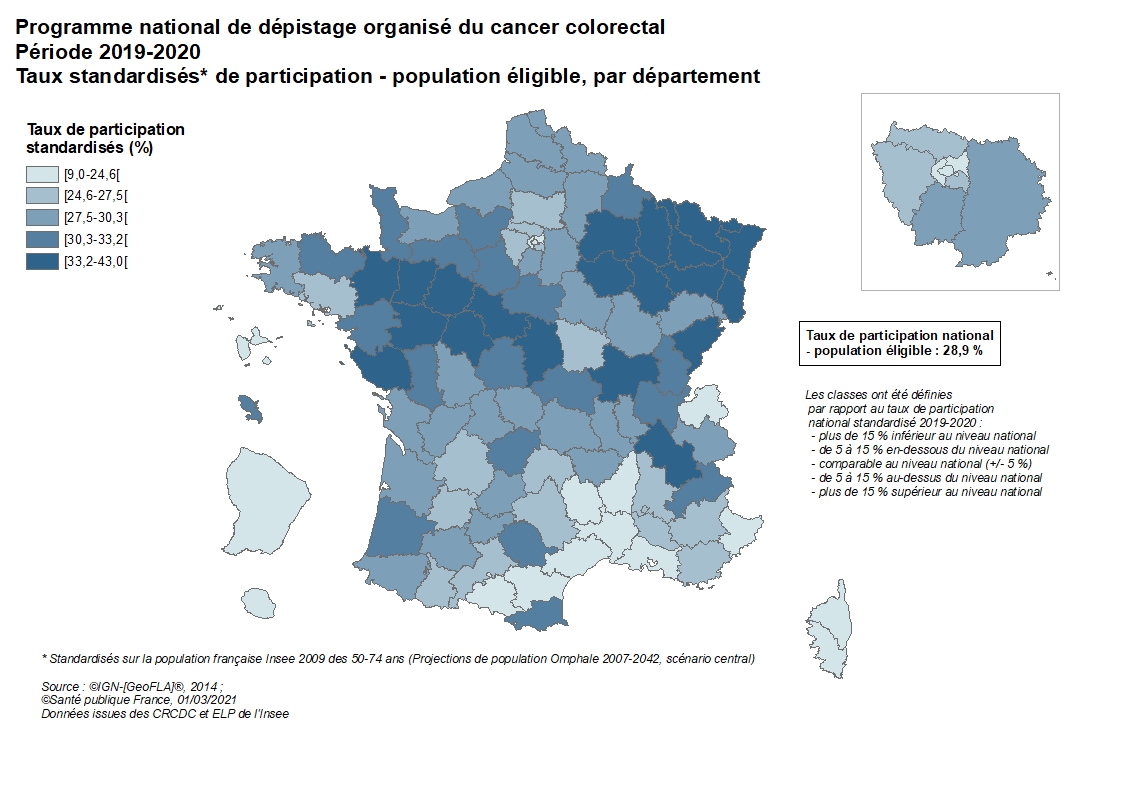
Participation rates are higher among women (30.0%) than among men (27.7%), and increase with age and vary by department:
Among men: from 25.9% among those aged 50–54 to 33.7% among those aged 70–74
Among women: from 27.6% among those aged 50–54 to 34.1% among those aged 70–74
The lowest rates are observed in French Guiana (9.0%), Corsica (14.9%), and Paris (17.0%)
The highest rates are observed in Haut-Rhin (42.9%), Bas-Rhin (42.2%), and Maine-et-Loire (41.3%)
183,500 people tested positive (3.7%), with a higher rate among men (4.4%) than among women (3.0%), which increases with age and varies by department:
Among men: from 3.7% among those aged 50–54 to 5.8% among those aged 70–74
Among women: from 2.8% among those aged 50–54 to 3.8% among those aged 70–74
It also varies by department, ranging from 2.8% to 4.4%
The proportion of people with an unanalyzed test that was not retaken during the same period is higher than in previous years (4.7% in 2020 compared to approximately 3% in other years). In 2020, in 80% of cases, tests were unanalyzed because they arrived at the testing laboratory after the deadline or had expired. The difficulties encountered by La Poste services and the lower priority given by screening participants to sending their tests due to the health crisis are the main hypotheses cited to explain the increase in the proportion of non-analysable tests in 2020.
Standardized participation rates by department, 2019–2020
Santé publique France’s roles in the surveillance and prevention of colorectal cancer:
Monitoring epidemiological trends in colorectal cancer
Evaluating the national organized screening program at the national, regional, and departmental levels
Promoting efforts to combat preventable risk factors