

Heat waves and extreme heat: launch of the seasonal monitoring program
The national heat wave plan has been in effect since June 1, 2021. Santé publique France has launched its seasonal monitoring initiative and is reminding the public of the preventive measures to take during periods of extreme heat.

Extreme heat, heat wave
thematic dossier
Heat waves can have a significant impact on health. It is therefore essential to take proper precautions. Certain measures must be put in place, especially for those most at risk.
As it does every year, from June 1 to September 15, Santé publique France coordinates the Heat Wave and Health Alert System in close collaboration with Météo France. As part of this seasonal monitoring and during heat waves, Santé publique France produces national and regional epidemiological summaries, in conjunction with the meteorological and health situation, and uses various communication tools to remind the public of simple steps to take to mitigate the health impacts of extreme heat.
Understanding the Risks to Better Respond During Heat Waves
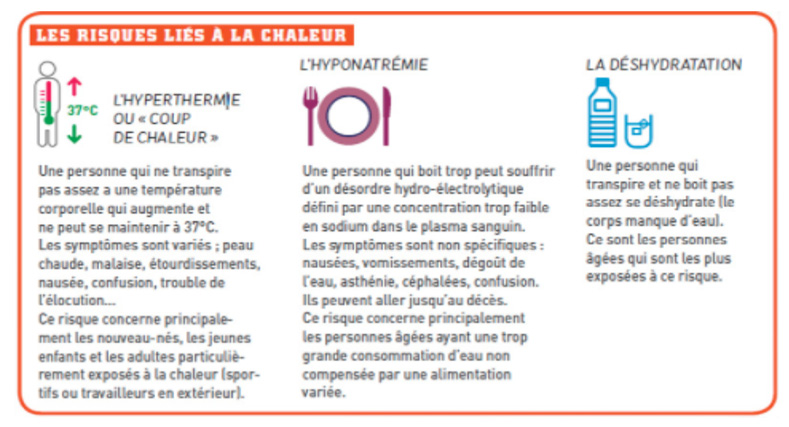
Heat has a very rapid impact. The health of the most vulnerable individuals can deteriorate quickly and require urgent care. Every year, during heat waves, there is an increase in medical care for conditions caused by heat exposure: heatstroke or hyperthermia, dehydration, and hyponatremia. The most severe cases can lead to serious long-term complications or even death.
Infographic: Heat-Related Risks
A tailored communication campaign to remind everyone that the heat wave affects us all
Santé publique France leads the prevention and communication initiative, in collaboration with the Ministry of Solidarity and Health, to raise public awareness based on heat alert levels. The goal is to empower everyone to protect themselves against the risks associated with extreme heat and to provide information on precautions to take, tailored to individuals’ physical condition, age, or specific exposure levels.
This year, the national “heat wave” communication campaign has been revised with one main goal: to raise awareness that everyone is affected by heat waves and their potential consequences.
New tools: a TV spot and a radio spot broadcast via media requisition in the event of a nationwide heat wave alert.
A targeted digital system: geolocated messages—via social media, screens in local stores, and text messages—sent to the most vulnerable individuals as soon as a department is placed under an orange alert.
New print materials: a poster—also translated into English—and two documents in the “Guidelines for Your Practice” series. Intended for healthcare professionals, they cover best practices to implement for the most vulnerable adults and children.
Santé publique France reminds the public of simple precautions everyone should take—including those in good health—to best combat the effects of heat
It is important to protect yourself, even when the heat is short-lived. These prevention tips apply to everyone, particularly vulnerable individuals (people over 65, people with disabilities or medical conditions, dependent individuals, pregnant women, young children, and the homeless) and workers exposed to heat, who are at higher risk of complications.
Avoid going outside during the hottest part of the day
Keep your home cool (close windows and shutters during the day; open them in the evening and at night if it’s cooler)
If you can’t keep your home cool, spend several hours a day in a cool place (movie theater, public library, supermarket, museum...)
Drink water regularly without waiting until you’re thirsty
Cool off and wet your body (at least your face and forearms) several times a day
Eat enough and avoid alcohol
Avoid physical exertion
Remember to check in with your loved ones regularly, and don’t hesitate to ask for help when needed
Check the Météo-France weather advisory website regularly for updates
When driving and on long trips
Remember to bring water and a spray bottle when traveling by car
Stop regularly to rest and cool off
At some highway rest areas, water fountains or misting stations are available
If possible, schedule your trip for cooler times of day
Never leave anyone alone in a car, especially a child, even for a few moments, as the temperature inside the vehicle can rise significantly and very quickly.
Get real-time updates and find remote assistance regarding health recommendations to follow during heat waves
For real-time information on weather conditions, you can consult the Météo-France weather advisory map, which is updated at least twice a day at 6 a.m. and 4 p.m.: https://vigilance.meteofrance.fr/fr. A "Heat Wave" information hotline, available at 0 800 06 66 66 (toll-free from a landline in France), is activated in the summer starting with the first heatwave by the Directorate General for Health (toll-free from a landline in France, from 9 a.m. to 7 p.m.) to answer questions and provide information on health recommendations to follow during periods of extreme heat.
Weather Alert Levels
A yellow weather alert corresponds to a heat wave: short-term exposure (1 or 2 days) to intense heat posing a risk to human health, particularly for vulnerable or overexposed populations due to their working conditions or physical activity. It may also correspond to a persistent heat episode: high temperatures (biometeorological indicators [IBM] near or below departmental thresholds) that persist over time (more than 3 days).
The orange weather alert level corresponds to a heatwave: a period of intense heat during which IBMs reach or exceed departmental thresholds for 3 consecutive days and nights, and which is likely to pose a health risk to the entire exposed population.
The red meteorological alert level corresponds to an extreme heat wave: a heat wave that is exceptional in terms of its duration, intensity, and geographic extent, with a significant health impact on all segments of the population, and which leads to collateral effects, particularly regarding business continuity.
Management and prevention measures are planned at the national and local levels for various institutional and field-level stakeholders, starting at the yellow level. These measures are described in the interministerial directive and the ORSEC guide “Health Management of Heat Waves,” which, as of this year, replace the former National Heat Wave Plan (PNC).
Reminder Regarding the 'Heat Wave and Health Alert System'
The Heat Wave and Health Alert System (SACS), established under the interministerial directive on "Health Management of Heat Waves," is in effect from June 1 through September 15. The activation of meteorological alert levels is contingent upon the simultaneous reaching or exceeding of departmental alert thresholds associated with minimum and maximum biometeorological indices (IBM), and the presence of aggravating factors. The IBM (min/max) values represent the average of the minimum and maximum temperatures forecast by Météo-France for the next three days (D, D+1, D+2). The main objective of this system is to prevent a significant impact of heat on public health by identifying alert thresholds based on daytime and nighttime temperatures above which the risk of death is likely to increase significantly.