visuel des affiches canicule 2020

Heat waves and extreme heat: monitoring and preventive measures tailored to the COVID-19 pandemic

The national heat wave plan has been in effect since June 1, 2020. Santé publique France has updated its heat wave monitoring system and prevention messages to provide new tools tailored to the context of the COVID-19 pandemic.

As it does every year, from June 1 to September 15, Santé publique France coordinates the Heat Wave and Health Alert System in close collaboration with Météo France. As part of this seasonal monitoring and during heat waves, Santé publique France produces national and regional epidemiological summaries, in conjunction with the meteorological and health situation, and uses various communication tools to remind the public of simple steps to take to mitigate the health impacts of extreme heat.

Understanding the Risks to Better Respond During Heat Waves

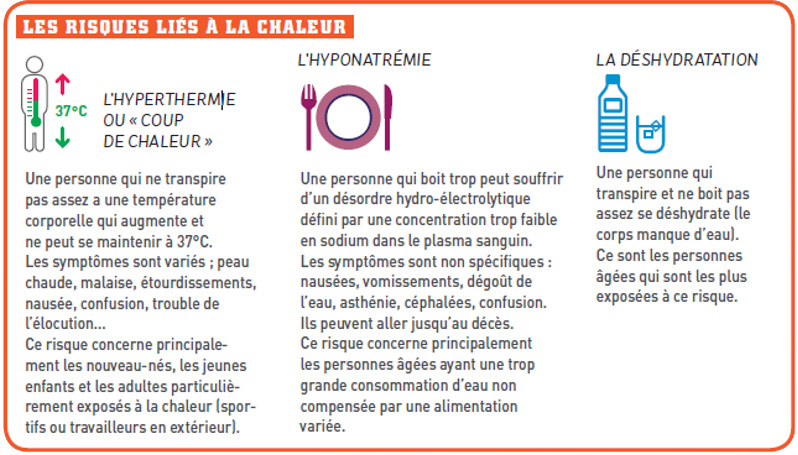
Heat has a very rapid impact. The health of the most vulnerable individuals can deteriorate quickly and require urgent care. Every year, during heat waves, there is an increase in healthcare utilization for conditions specifically or largely caused by heat exposure: heatstroke or hyperthermia, dehydration, and hyponatremia. The most severe cases can lead to serious long-term complications or even death.

Schéma risque liés à la chaleur

As part of the National Heat Wave Plan, Santé publique France leads the prevention and communication efforts, in collaboration with the Ministry of Solidarity and Health, to raise public awareness based on alert levels.

The goal is to empower everyone to protect themselves against the risks associated with extreme heat and to provide information on precautions to take and adapt based on an individual’s physiology, age, or specific exposure levels.

FOCUS - Heat Waves and Extreme Heat Amid the COVID-19 Pandemic

In 2020, Santé publique France is adapting health surveillance and measures to prevent the consequences of heat waves in the context of the COVID-19 pandemic. The pandemic situation is considered an aggravating factor in heat wave monitoring, given that the populations at risk are largely the same for both COVID-19 and extreme heat (the elderly, people with chronic conditions, those who are obese, etc.).

The national communication strategy is also being revised. Regardless of the medium used (TV spots, radio spots, posters), heatwave prevention messages are adapted to the context of the pandemic and supplemented with messages reminding the public of protective measures against COVID-19.

New tools are being made available :

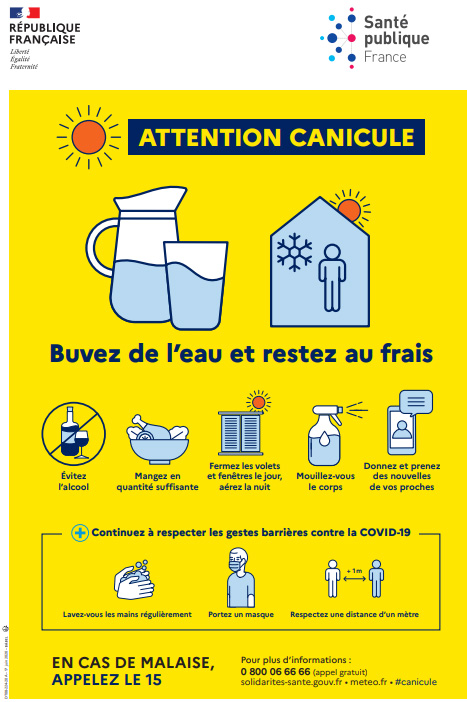
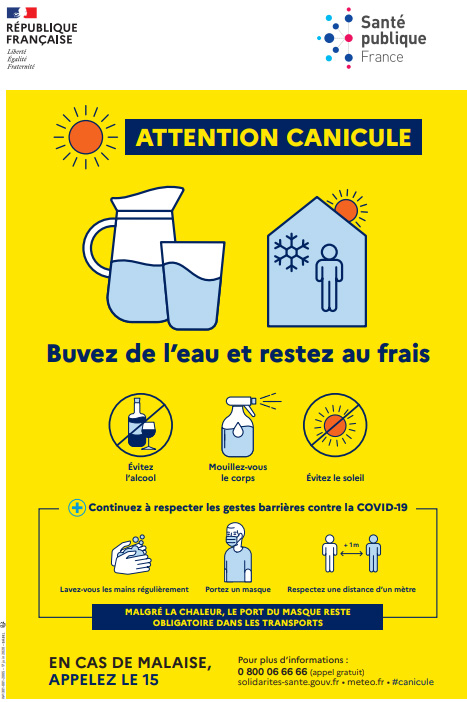
  • a general-interest ad and two “heatwave and COVID-19” posters (French/English) will be displayed in tourist areas, including one specifically on public transportation,

  • an audio press kit consisting of 1-minute-30-second radio interviews with experts. It reflects a commitment to developing a targeted approach so that everyone realizes that heatwaves, to varying degrees, affect the entire population,

  • in addition, and in case of emergency, two TV spots and two radio spots on preventive measures and warning signs will be broadcast during heat waves.

affiche canicule tout public 2020
affiche canicule transport 2020

Posters for the general public and public transportation are available in A4, 40x60, and 62x100 cm formats (see the posters).

Measures and actions to take before, during, and after heat waves

The adoption by everyone of simple, cautious behaviors and a spirit of solidarity is the cornerstone of prevention. Santé publique France reiterates the simple guidelines to follow, which apply to everyone (including healthy individuals), to combat the effects of heat, even during short-lived heat waves.


Get real-time updates and find remote assistance regarding health recommendations to follow during heat waves

For real-time information on weather conditions, you can consult the Météo-France weather advisory map, which is updated at least twice a day at 6 a.m. and 4 p.m.: https://vigilance.meteofrance.fr/fr. A "Heat Wave" information hotline, available at 0 800 06 66 66 (toll-free from a landline in France), is activated in the summer starting with the first heatwave by the Directorate General for Health (toll-free from a landline in France, from 9 a.m. to 7 p.m.) to answer questions and provide information on health recommendations to follow during periods of extreme heat.

See also

HCSP Opinion of May 6, 2020, on recommendations regarding the management of the COVID-19 epidemic in the event of public exposure to heat waves

Weather Alert Levels

  • Level 1 "seasonal watch" of the PNC corresponds to the green heat wave alert level on the Météo-France alert map.

  • Level 2 'heat advisory' of the PNC corresponds to the yellow heatwave alert level in the event of a temporary heat spike lasting one or two days, a period of intense heat without reaching alert thresholds, or a high probability of transitioning to an orange heatwave alert in the coming days.

  • Level 3 'heatwave alert' of the PNC is triggered by departmental prefects, in coordination with regional health agencies, based on the transition to an orange heatwave alert.

  • Level 4 – 'maximum mobilization' corresponds to the transition to a red heatwave alert in the event of a confirmed heatwave of exceptional intensity, with or without the occurrence of major collateral effects in sectors of vital importance (drought, drinking water supply, overcrowding of hospitals or funeral homes, etc.).

Reminder Regarding the 'Heat Wave and Health Alert System'

The Heat Wave and Health Alert System (SACS), established under the National Heat Wave Plan (NHP), is in effect from June 1 through September 15. The activation of the National Heat Wave Plan’s alert levels is triggered when departmental alert thresholds associated with minimum and maximum biometeorological indices (IBM) are simultaneously reached or exceeded. The IBM (min/max) values represent the average of the minimum and maximum temperatures forecast by Météo-France for the next three days (D, D+1, D+2). The main objective of this system is to prevent a significant impact of heat on public health by identifying alert thresholds based on daytime and nighttime temperatures above which the risk of death is likely to increase significantly.

Fortes chaleurs, canicule

Extreme heat, heat wave

thematic dossier

Heat waves can have a significant impact on health. It is therefore essential to take proper precautions. Certain measures must be put in place, especially for those most at risk.

Heat wave