
Evaluation of the Good Behavior Game (GBG), a program for developing social-emotional skills in elementary school
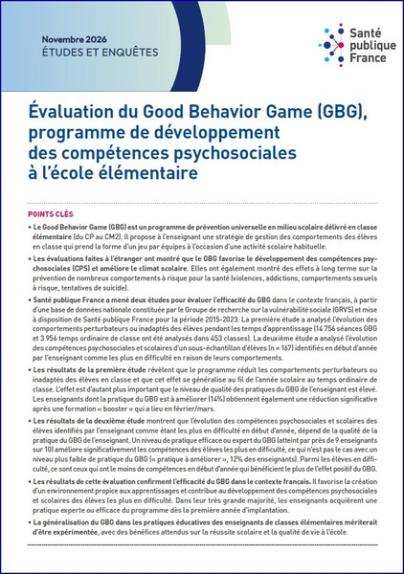
The Good Behavior Game (GBG) is a universal prevention program for schools implemented in elementary grades (from CP to CM2). It provides teachers with a strategy for managing student behavior in the classroom in the form of a team-based game incorporated into a regular school activity.; Evaluations conducted abroad have shown that the GBG promotes the development of psychosocial skills (PSS) and improves the school climate. They have also demonstrated long-term effects on the prevention of numerous health-risk behaviors (violence, substance abuse, risky sexual behavior, suicide attempts).; Santé publique France conducted two studies to evaluate the effectiveness of GBG in the French context, using a national database compiled by the Research Group on Social Vulnerability (GRVS) and made available to Santé publique France for the period 2015–2023. The first study analyzed changes in disruptive or inappropriate student behavior during learning sessions (14,756 GBG sessions and 3,956 regular class periods were analyzed across 453 classes). The second study analyzed changes in the psychosocial and academic skills of a subsample of students (n = 167) identified at the beginning of the school year by the teacher as those experiencing the greatest difficulties due to their behavior.; The results of the first study reveal that the program reduces disruptive or inappropriate student behavior in the classroom and that this effect extends to regular classroom time over the course of the school year. The effect is even more pronounced when the teacher’s GBG practices are of high quality. Teachers whose GBG practices need improvement (14%) also achieved a significant reduction following a “booster” training session held in February/March. The results of the second study show that the improvement in the psychosocial and academic skills of students identified by the teacher as having the greatest difficulties at the beginning of the year depends on the quality of the teacher’s GBG practices. An effective or expert level of GBG practice (achieved by nearly 9 out of 10 teachers) significantly improves the skills of the students facing the greatest challenges, which is not the case with a lower level of GBG practice (“practice in need of improvement,” 12% of teachers). Among students facing challenges, those with the lowest skill levels at the beginning of the school year benefit the most from the positive effects of GBG; The results of this evaluation confirm the effectiveness of the GBG in the French context. It fosters the creation of an environment conducive to learning and contributes to the development of psychosocial and academic skills among the students with the greatest difficulties. The vast majority of teachers develop expert or effective implementation of the program as early as the first year of implementation.; The widespread adoption of GBG in the educational practices of elementary school teachers warrants further exploration, with expected benefits for academic success and quality of life at school.
Author(s): Lecrique Jean-Michel, du Roscoät Enguerrand
Publishing year: 2026
Pages: 13 p.
Collection: Studies and Surveys
In relation to
Our latest news

news
Good Behavior Game: An Effective Program for Improving the School Climate...

news
Public Health France Conference: November 9, 2026

news