


In 2026: Stepped-up efforts to combat the tiger mosquito! Activation of the surveillance and control system for diseases transmitted by the tiger mosquito
cp_lav_moustique_paca_20260507.pdf
Download (PDF - 419.38 KB)
Press Contact
Provence-Alpes-Côte d'Azur Regional Health Agency
Communications
Department Tel: 04 13 55 83 70
ars-paca-communication@ars.sante.fr
The tiger mosquito surveillance season began on May 1 under unusual circumstances: in 2025, our region recorded an unprecedented number of locally transmitted cases of chikungunya and dengue. Now more than ever, it is essential for professionals, local authorities, and the general public to work together to prevent transmission and limit the spread of the mosquito.
More than 97% of the population in the Provence-Alpes-Côte d’Azur region lives in an area where the
tiger mosquito is present; this mosquito is a vector for the dengue, chikungunya, and Zika viruses. After spending the winter in the egg stage and following the rise in temperatures and longer days, the larvae can now develop into adult tiger mosquitoes capable of biting.
A significant risk of local transmission in our region
Unlike an imported case—where someone returns from travel with one of these diseases—an indigenous case occurs
when a person contracts the disease within France without having
traveled abroad.
In 2025, between early June and early November, 450 indigenous cases of chikungunya and 16 indigenous cases
of dengue were recorded in the Provence-Alpes-Côte d’Azur region, spread across 35
distinct transmission episodes (primarily in the Alpes-Maritimes, Var, and Bouches-du-Rhône departments
). Our region was the hardest hit, accounting for nearly 60% of cases identified in
mainland France (see the report from Santé Publique France). It had never before experienced such a
high number of locally acquired cases; a clear upward trend in case numbers
has been observed since 2022, making our region the most at risk of
local transmission across mainland France.
The surveillance and response system
The ARS Paca, Santé publique France, and their partners are informing the public and mobilizing healthcare professionals to improve case identification.
Any confirmed case of dengue, chikungunya, or Zika—whether imported or locally transmitted—must be reported to the ARS Paca. Each of these cases is then investigated by the ARS, in collaboration with the regional unit of Santé publique France, to identify potential sites of infection and risks of spread, and to implement the necessary protective measures.
In this regard, the Interdepartmental Agreement for Mosquito Control (EID) of the Mediterranean coast is responsible in the region, on behalf of the ARS Paca, for monitoring the tiger mosquito and implementing the necessary control and protection measures around confirmed cases.
Operation Zero Mosquitoes: Ready-to-Use Tools for Local Governments!
Operation Zero Mosquito is a community mobilization event organized by local governments and associations in the region in collaboration with the PACA Regional Health Agency. It takes place from May to November (the tiger mosquito’s active season) during local events.
Recognize the telltale symptoms and know how to protect yourself and others
If you are returning from an area where dengue, chikungunya, or Zika are circulating (primarily the intertropical zone), it is important to take the right precautions to prevent spreading the disease.
Here’s what to do:
- Consult your primary care physician immediately if you experience symptoms of dengue, chikungunya, or Zika (in the absence of respiratory symptoms) and inform them of
your recent travel:- sudden onset of fever
- muscle and/or joint pain
- headache
- skin rash
- Protect yourself from mosquito bites:
- wear loose-fitting, long-sleeved clothing;
- apply a repellent specifically designed for tiger mosquitoes to exposed skin;
- use fans, which deter mosquitoes;
- install mosquito screens on openings (doors and windows).
More generally, everyone can effectively combat the spread of the tiger mosquito by regularly eliminating its breeding sites.
Simple steps can effectively eliminate breeding sites; take these steps and tell your neighbors:
- empty small pools of water once a week, especially plant
saucers; - seal water containers (barrels, jugs,
etc.) tightly with a cover or cover them with a mosquito net; - store anything that can hold water (buckets, watering cans, children’s
toys) in a place sheltered from the rain; - collect yard waste and clean the gutters.
A day organized by and for healthcare professionals on June 2 in Marseille
Healthcare professionals play a vital role in the prevention, surveillance, and control of diseases transmitted by the tiger mosquito. Their early diagnosis and reporting enable health authorities to implement management measures to limit the risk of local transmission.
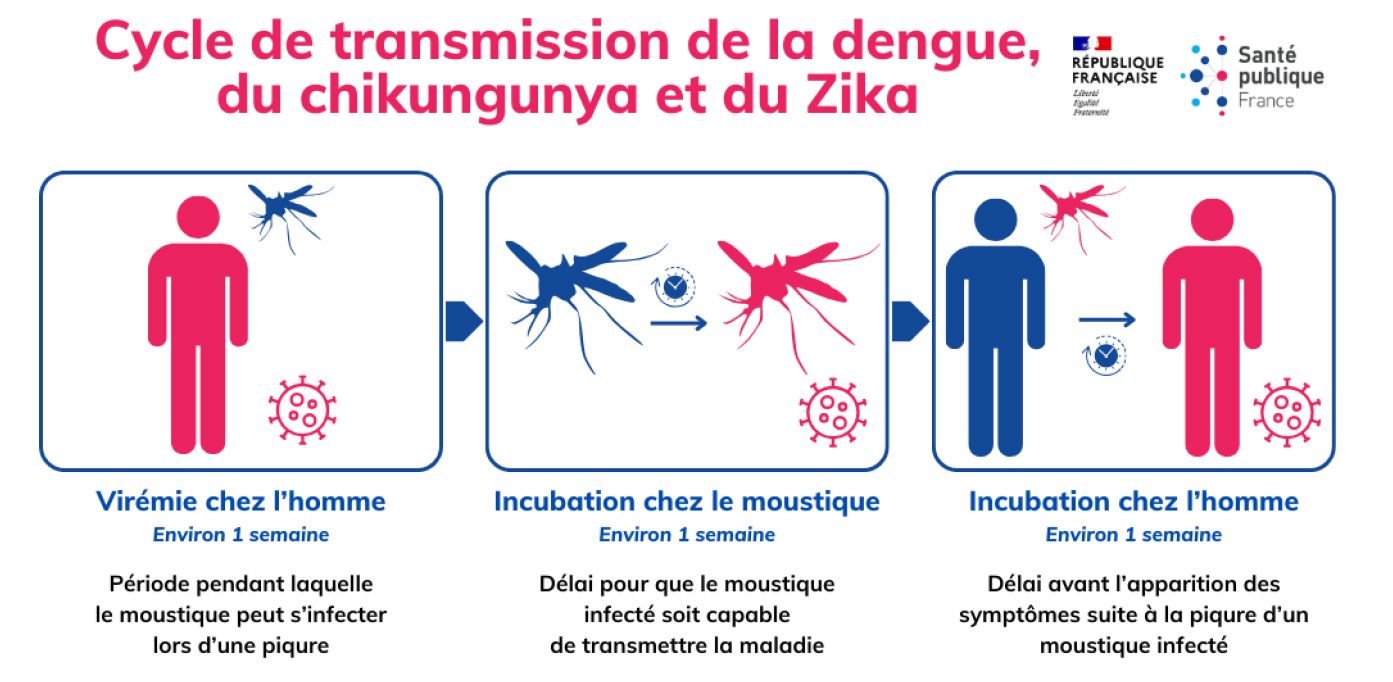
How Chikungunya, Dengue, and Zika Are Transmitted
Dengue, chikungunya, and Zika are diseases that circulate in tropical regions and
can be introduced into France by travelers returning from abroad when they are
carrying the virus in their blood (during the so-called viremia phase). In France, these diseases are
transmitted by the tiger mosquito. After biting an infected person, the tiger
mosquito can, after a period of one week, infect another healthy person by transmitting
the virus to them.

Chikungunya
thematic dossier
Chikungunya is a viral disease transmitted by mosquitoes of the genus Aedes. The most common symptoms are fever and joint pain.

Dengue
thematic dossier
Dengue fever is a viral disease transmitted by mosquitoes of the genus Aedes. The most common symptoms are fever and joint pain. Its complications can be severe.

Zika
thematic dossier
Zika is a viral disease transmitted primarily by mosquitoes but also through sexual contact. Symptoms are usually mild, but the virus can cause birth defects if a woman becomes infected during...
Our latest news

news
Growing Up with Screens. A special report in *La Santé en action* No. 474,...

news
Seniors, pregnant women, and nursing home staff: What is the status of their...

news