
COVID-19 Epidemiological Update for October 22: The outbreak is accelerating, with people over 65 particularly affected
CP_pe_covid_221020.pdf
Download (PDF - 637.1 KB)
Press Contacts
Santé publique France
presse@santepubliquefrance.fr
Stéphanie Champion: 01 41 79 67 48
Marie Delibéros: 01 41 79 69 61
Camille Le Hyaric: 01 41 79 68 64
Published weekly, the epidemiological update on COVID-19 surveillance provides a detailed analysis of the various indicators established by Santé publique France and its network of partners to track the progression of the epidemic and inform public policy decisions. The epidemiological update of October 22 shows that monitoring indicators are rising sharply, indicating an acceleration of the epidemic in mainland France. The highest level of vigilance must be maintained for people over 65, who are at the highest risk of COVID-19 complications and among whom there are six times as many cases and five times as many hospitalizations and intensive care admissions compared to early September.
Hospital and ICU metrics on the rise as the outbreak accelerates
In week 42 (October 12–18), 168,772 new confirmed cases of COVID-19 were recorded, a 38% increase compared to the 122,169 cases in week 41 (October 5–11). The positivity rate (+1.4 percentage points), the number of SOS Médecins calls (+15%), emergency room visits for suspected COVID-19 (+35%), and the number of new SARS-CoV-2 positive cases in long-term care facilities—all indicators tracking the epidemic are showing a sharp increase, particularly new hospitalizations, ICU admissions, and deaths.
Between weeks 41 and 42, new hospitalizations and ICU admissions increased by 48%: 7,530 new hospitalizations of COVID-19 patients versus 5,084 in week 41, and 1,343 new ICU admissions versus 910. As of October 20, 12,458 people were currently hospitalized, including 2,177 in intensive care. An intensive care admission is defined as admission to intensive care units, intensive care wards, and continuous monitoring units, without the ability to distinguish between them. This definition has not changed since the start of surveillance.
The number of COVID-19-related deaths (including deaths in hospitals and deaths in long-term care facilities and other nursing homes) increased by 40% (764 in week 42 versus 546 in week 41).
Protecting vulnerable people is crucial
In week 42, the incidence rate increased compared to week 41 across all age groups. The sharpest increases in this rate were among those aged 75 and older (+67%), followed by those aged 65–74 (+58%), those aged 45–64 (+46%), then those aged 15–44 (+31%), and those aged 0–14 (+37%).
The rise in the number of cases among the elderly is very concerning. Those most severely affected by this outbreak are people aged 65 and older, as well as those with underlying health conditions. In fact, in week 42, 65% of those admitted to intensive care were over 65 years old, and 90% had underlying health conditions.
In week 42, 4,981 people aged 65 and older were hospitalized, and 856 were admitted to intensive care. Since early September (week 36), the number of people aged 65 and older hospitalized and admitted to intensive care has increased fivefold.
Focus on what’s new in this Epidemiological Update
Data at the metropolitan level
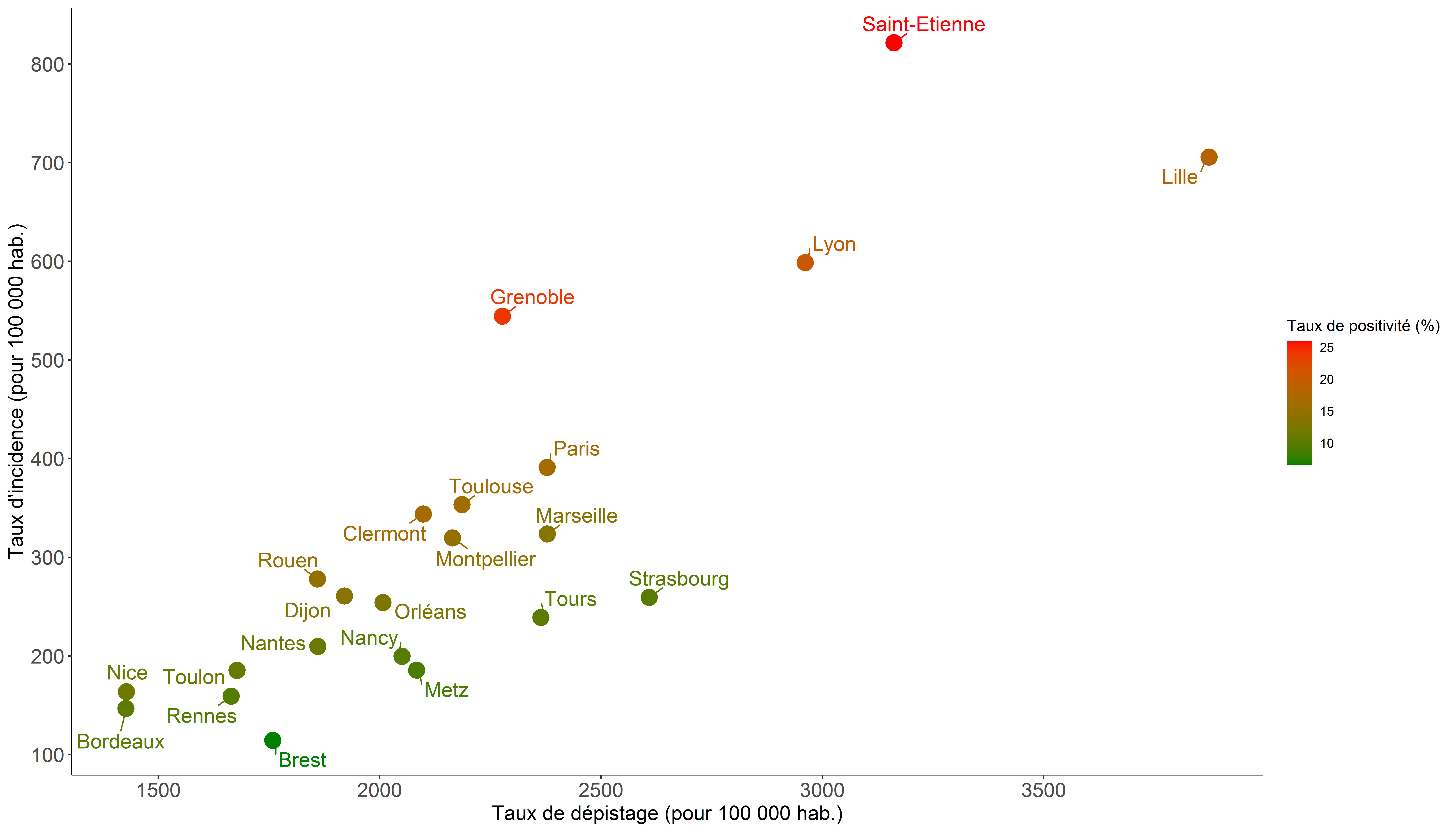
On October 15, Santé publique France made available on Géodes the rolling weekly incidence rates for “all ages” and “65 and older” for 22 metropolitan areas. Since October 21, these indicators have also been available at the sub-departmental level and supplemented with positivity rates and testing rates (for more information: press release / FAQ).
The analysis of data at the metropolitan level is published for the first time in this national epidemiological update. The aim is to track, week by week, the evolution of the incidence rate in metropolitan areas and to interpret it for each one in light of the positivity rate and testing rate, which influence its evolution.
A Shift in the Timing of Cluster Data Releases
Following the end of lockdown, while the virus was circulating at low levels, Santé publique France had established a reporting system designed to alert authorities to clusters. The identification of clusters and the management measures implemented were intended to help break transmission chains. Given the increase in viral circulation across the country, the number of identified clusters is currently significantly underestimated, and their identification is no longer a useful indicator for monitoring the epidemic. In this context, the cluster report will now be published every two weeks in the epidemiological update.
Stay informed about the COVID-19 pandemic in France and around the world
Updates, Q&As, expert interviews... everything you need to know about the novel coronavirus (SARS-CoV-2) and COVID-19 in France and around the world
Our latest news

news
Growing Up with Screens. A special report in *La Santé en action* No. 474,...

news
Seniors, pregnant women, and nursing home staff: What is the status of their...

news