No alcohol during pregnancy: a key preventive measure to protect your baby
cp_alcool_grossesse_20261123.pdf
Download (PDF - 247.91 KB)
Press Contacts
Santé publique France
presse@santepubliquefrance.fr
Stéphanie Champion: 01 41 79 67 48
Marie Delibéros: 01 41 79 69 61
Camille Le Hyaric: 01 41 79 68 64
Santé publique France and the Ministry of Health are launching a campaign, running through December 31, to raise awareness about the risks of alcohol consumption during pregnancy. In fact, no level of alcohol consumption can be guaranteed to be risk-free for the baby (premature birth, heart defects, learning difficulties, etc.). This campaign reinforces the essential preventive principle: zero alcohol during pregnancy.
An Underestimation of the Number of People Affected by Alcohol-Related Disorders During Pregnancy
It is estimated that in France, at least one birth per day is affected by a fetal alcohol spectrum disorder (FASD), including one birth per week with fetal alcohol syndrome (FAS)¹—the most severe form (malformations, growth retardation, intellectual disability, etc.). The more alcohol a pregnant woman consumes, the greater the risks and harm, but no level of consumption can be guaranteed to be risk-free. These figures, which are likely underestimated, underscore the importance of reinforcing the “zero alcohol during pregnancy” message for expectant parents and of providing support to pregnant women struggling with their alcohol use, as well as to their partners. The latest recommendations encourage avoiding all alcohol consumption as soon as a couple begins planning to have a child.²
Recommendations Are Well-Known, but Practices Need to Be Strengthened
While 9 out of 10 French people are aware of the zero alcohol during pregnancy recommendation, certain misconceptions and misunderstandings persist. For example, one-quarter of them believe that having a drink on a special occasion would be safe.³ Other beliefs persist: that alcohol poses risks mainly at certain stages of pregnancy, that beer promotes breastfeeding, or that there is a difference in risk between a glass of light alcohol and a glass of hard liquor. However, no amount of alcohol consumption can be considered risk-free, regardless of the type of alcohol, the quantity, or the stage of pregnancy. Conversely, it is always beneficial for a healthy pregnancy and the baby’s well-being to stop drinking at any time.
The Key Role of Support Networks
Support networks—partners, family, and friends—are often the primary source of information, even before healthcare professionals. They can also help create an environment that supports zero alcohol consumption during pregnancy: in 2025, 45% of respondents⁴ believed that not drinking in front of a pregnant woman could help her avoid drinking alcohol. Active support from loved ones can play a decisive role, particularly for women in vulnerable situations. If needed, healthcare professionals and counselors at Alcool Info Service can also provide non-judgmental support to pregnant women struggling with their alcohol use.
A campaign to raise awareness, provide information, and offer help
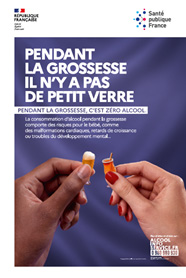
From November 23 to December 31, 2026, Santé publique France and the Ministry of Health are launching a campaign aimed at highlighting the risks of alcohol consumption during pregnancy to the health of both mother and child and reiterating the recommendation: zero alcohol during pregnancy. Posters, social media posts, an educational video, and media partnerships (M6, WeMoms) will target expectant parents and their support networks with a clear message: “During pregnancy, there’s no such thing as ‘just one drink.’”
Learn More
- Pregnancy and Breastfeeding | alcool-info-service.fr
- Alcohol During Pregnancy and Breastfeeding | 1000-premiers-jours.fr
1 Prevalence and Characteristics of Heavy Prenatal Alcohol Exposure in France, 2015–2024: Analyzing the French National Health Insurance (SNDS) Database. (page 49). Crassous, Agnès; Barry, Yaya; Demiguel, Virginie; Alla, François; Schwarzinger, Michaël
2 Providing Support from the First Point of Care to Reduce Alcohol-Related Risks for Women | Haute Autorité de santé
3,4 Knowledge and perceptions of alcohol use during pregnancy: What do the French say in 2025? | Santé publique France

Alcohol
thematic dossier
Alcohol is deeply rooted in French culture. Its consumption remains a major cause of death and illness in France.
Alcohol Information Service
Alcohol Info Service offers alcohol users and their loved ones help, information, support, guidance, and advice online or by phone (anonymous, toll-free calls available 7 days a week...
The First 1,000 Days
A website that provides guidance to expectant parents and parents of children up to two years old on how to create an environment that supports their child’s development.
Our latest news

news
Odissé Dataviz Challenge: Winners Honored at the Santé publique France...

news
Call for Nominations to Fill Vacancies on the National Reference Centers...

news