
Guidelines for Implementing Participatory Approaches at Santé publique France. Part 2. Citizen Participation in Local Health and Environment Investigations
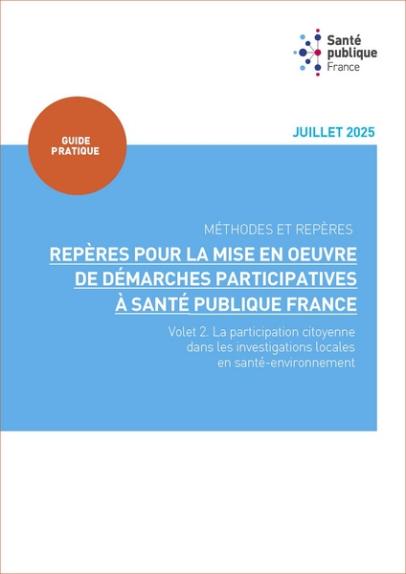
This second section is devoted to local environmental health investigations. It was drafted by a working group comprising representatives from the agency’s various departments and volunteer members of the Steering and Dialogue Committee (COD). This field of environmental health has several distinctive features: the situations giving rise to complaints vary widely, the pathologies involved are multifactorial, environmental exposures are numerous, the latency periods between exposure and the onset of health effects can be long, and, from an etiological perspective, there are still many scientific uncertainties. The difficulties in reaching conclusions regarding causation are sources of widespread misunderstanding and tension between experts and stakeholders. These situations give rise to concerns, and even distress, among the residents and families affected. They require the involvement of various stakeholders in contact with the public (health professionals, elected officials, local authorities, associations, etc.). Such situations often resonate across regions, and their impact can be significant at the national level. This document outlines the various stages of the participatory approach to be developed. As a first step, an initial analysis of the context in which the complaint arose, based on interviews with key stakeholders, is recommended. If this context is deemed sensitive based on defined criteria, a more in-depth analysis of the issues, expectations, positions, and local actions is recommended. This will help identify the public health investigations best suited to address this request, as well as pinpoint differences in perspective among local stakeholders. On this basis, Santé publique France and other institutional experts will provide the most appropriate responses. This phase will also help identify the stakeholders to be involved in the committee process and precisely sequence the steps of the participatory framework, the principles of which were outlined in the first volume of the guide. A series of practical fact sheets on the identification and mobilization of stakeholders, as well as the concrete procedures for conducting local context studies, is presented. This guide is intended for Santé publique France teams but may be useful to a wider audience.
Author(s): Perrey Christophe, Le Lay Emmanuelle
Publishing year: 2025
Pages: 38 p.
Collection: Method
In relation to
Our latest news

news
SIBCA 2026: The UrBaCS network presents its solutions for cities and...

news
Physical Activity and Combating a Sedentary Lifestyle: How Does Santé...
news