
Health of Middle School Students in France: New Data from the 2014 HBSC Survey
For adolescents, middle school years are a time of change. The international HBSC (Health Behaviour in School-aged Children) survey, conducted every four years in more than 40 countries, provides an accurate snapshot of the health and well-being of adolescents aged 11 to 15 and tracks changes over time. It is the only survey of its kind. Santé publique France is participating for the sixth consecutive year. The 2014 French data are being published today in the form of thematic fact sheets.

The French component of the HBSC survey is coordinated by the medical department of the Toulouse Regional Education Authority under the direction of Dr. Godeau, with the collaboration and financial support of Santé publique France, as well as Inserm U1027 and the OFDT.
In 2014, more than 7,000 middle school students responded to the survey in 169 public and private schools in metropolitan France, revealing through their responses significant differences based on gender, age, and socioeconomic background.
"A majority of adolescents feel pretty good"
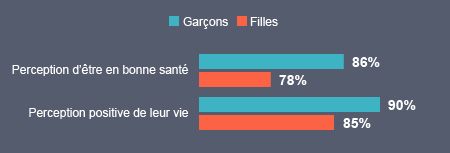
Overall, 88% of middle school students feel healthy, and 82% have a positive outlook on life (boys more so than girls).
"Marked social inequalities in health status and behaviors"
The proportion of middle school students reporting excellent health is significantly higher in more affluent socioeconomic backgrounds (41%) compared to less affluent ones (34%).
Obesity and overweight are more prevalent among less privileged students compared to more privileged ones (18% vs. 8%), and students who report not engaging in any physical activity are also more often from the most disadvantaged families (7.9% vs. 2.4%).
Eating breakfast daily on school days is more common among the most advantaged students (66%) than among the least advantaged (58%).
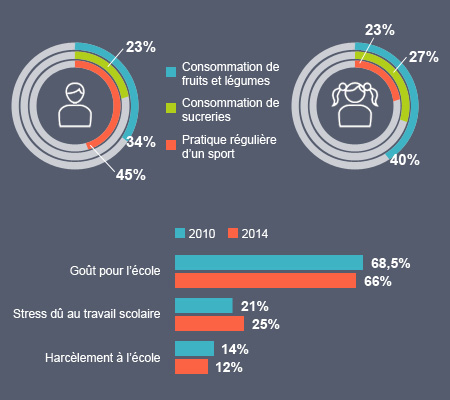
Daily consumption of fruits and/or vegetables, which applies to an average of two-thirds of middle school students, is higher in the most advantaged families (68% vs. 57%), whereas the opposite is true for sugary drinks (26% vs. 35%).
Brushing teeth at least twice a day, in accordance with recommendations, is more common among students from the most affluent families (82%) than among students from the least affluent families (72%).
"Positive trends…
The survey highlights changes in middle school students’ behaviors, such as an increase in tooth brushing, a decrease in violence and bullying, and an increase in regular participation in sports…
… but also negative ones"
The survey reveals a more negative perception of life among girls, more frequent recurring psychological complaints (depression, irritability…) and/or somatic complaints (back pain, headaches…), increased stress due to schoolwork, a decline in condom use during the last sexual encounter, and a decline in daily consumption of fruits and/or vegetables.