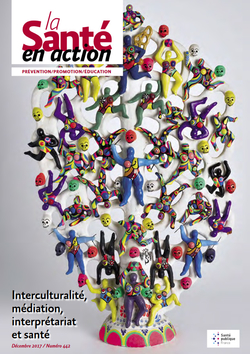
Interculturality, Mediation, and Interpretation: The Special Issue of *La Santé en action* No. 442, December 2017
In the December 2017 issue of its quarterly journal *La Santé en action*, Santé publique France publishes a special feature on the theme of "interculturality, mediation, and interpretation," which provides an overview of current knowledge and highlights innovative programs and initiatives in this field.
Why are mediation and intercultural understanding necessary to improve relationships between healthcare and educational institutions and their users?
For various public service institutions (hospitals, schools, medical-social centers, etc.), welcoming the public and developing tailored support requires taking into account a range of factors, including cultural aspects. These factors influence not only health status and perceptions of health but also behaviors related to health and illness.
In fact, these institutions organize their intercultural relationships with users empirically by taking into account factors such as age, gender, social status, value systems, traditions, lifestyle habits, personal history, and so on.
One of the primary aspects of this mediation is linguistic and corresponds to the role of an interpreter, which also requires knowledge of the patient’s culture to analyze unspoken meanings, cultural codes, and so on. The health mediator, for their part, acts as an interface between healthcare professionals and vulnerable populations to facilitate the latter’s access to rights regarding health coverage, prevention, and care.
About fifteen experts and field professionals contributed to the development of the main feature of this issue, which is dedicated to interculturality, mediation, and interpreting. Taking these three concepts into account in healthcare, preventive health, and education is a major requirement.
This feature illustrates the diversity of perspectives and highlights existing programs and initiatives in this field in the relevant settings. Even when practiced, the intercultural dimension remains largely overlooked, particularly in terms of its theoretical principles and implications.
It prompts reflection on interculturality, mediation, and interpreting through multiple approaches: anthropology of the relationship with the other, normative institutional mechanisms (such as best-practice protocols leading to standardized attitudes), power dynamics between caregivers ("experts") and patients ("laypeople"/"uninformed"), the principle of secularism, cultural misunderstandings, cultural diversity (for example regarding modesty), pitfalls of translation, contributions of transcultural school mediation, "peer-tutor" student programs, "humanization" of care…
Mediation and Health
Health mediation draws on the experiences of family mediation and judicial mediation. It facilitates mutual understanding among all stakeholders in the healthcare system, an understanding hindered by differing practices and approaches to care. Acting as an intermediary between the institution and the individual, it benefits the elderly, the poor and vulnerable, migrants, overseas populations, prisoners…, that is, anyone who is more or less distanced from the healthcare system. This mediation, which fosters the individual’s unique capacity to care for themselves, has been the subject of training programs since the late 1990s. The Healthcare System Modernization Act of January 26, 2016, provided it with a legal framework and a definition that clearly distinguishes it from medical interpretation, emphasizing autonomy in the healthcare journey and access to patients’ rights.
Medical-Social Interpretation
When there is a language barrier, unequal relationships are established. Every patient must understand the interventions proposed to them in order to give informed consent and engage their own capabilities. Language is therefore key to better care and prevention, but also an ethical requirement. The need to use a professional interpreter during medical consultations with non-native-speaking patients was recognized and enshrined in French law by the 2016 Healthcare System Modernization Act. The High Authority for Health, for its part, has developed the framework of competencies, training, and best practices corresponding to this profession. This report highlights certain initiatives in this area but also emphasizes that a lack of organization and financial support means that the use of trained interpreters remains little known in France and largely inaccessible to professionals in the medical-social sector, who default to using free digital translation tools.
Learn more:
Interculturality, Mediation, and Interpreting in Healthcare. La Santé en action No. 442 – December 2017. 52 p.
La Santé en action is the quarterly journal of Santé publique France dedicated to prevention, education, and health promotion. It is fully accessible in digital format. The print version is reserved for professionals working in public settings (schools, hospitals, etc.).