

World Diabetes Day, November 14, 2017
In France, in 2015, more than 3.3 million people were receiving medication for diabetes. Furthermore, type 1 diabetes is affecting an increasing number of children: in 2015, more than 2,200 children were diagnosed with type 1 diabetes for the first time. To mark World Diabetes Day on November 14, 2017, Santé publique France is publishing a weekly epidemiological bulletin (BEH) focused primarily on type 1 diabetes in children.
Overview of the Disease
Diabetes mellitus is a metabolic disorder characterized by chronic hyperglycemia (high blood sugar levels) resulting from a deficiency in insulin secretion or insulin action, or both. There are two main types of diabetes:
Type 1 (about 6% of diabetes cases) occurs primarily in children or young adults. It is caused by the destruction of the pancreas’s beta cells, resulting in the affected person’s inability to produce insulin. This is why it often has an acute onset in children and adolescents, particularly in younger individuals, with a very rapid progression toward ketoacidosis*. Insulin injections are vital for these individuals;
Type 2, which is the most common form (about 92%), occurs primarily in adults but can also appear as early as adolescence. It can progress without symptoms for several years. Screening is performed on an empty stomach via a blood test to measure blood glucose levels. An abnormal result (above 1.26 g/L or 7 mmol/L) must be confirmed by a second test. Type 2 diabetes can be treated with diet alone, oral antidiabetic medication, GLP-1 analog injections, or insulin injections.
There are also other forms of diabetes, such as gestational diabetes (which occurs during pregnancy and usually resolves after childbirth), or cases of diabetes resulting from specific medical conditions or genetic factors.
As the disease progresses, diabetes can lead to serious complications affecting the heart, blood vessels, eyes, kidneys, and nerves. However, good management of the disease can significantly reduce the risk of complications.
Key figures and findings
Incidence of type 1 diabetes in children
In France, as in Europe, the incidence of type 1 diabetes has doubled over the past 30 years among children and adolescents
Between 2013 and 2015, more than 6,000 children were diagnosed with type 1 diabetes for the first time, including more than 2,200 in 2015
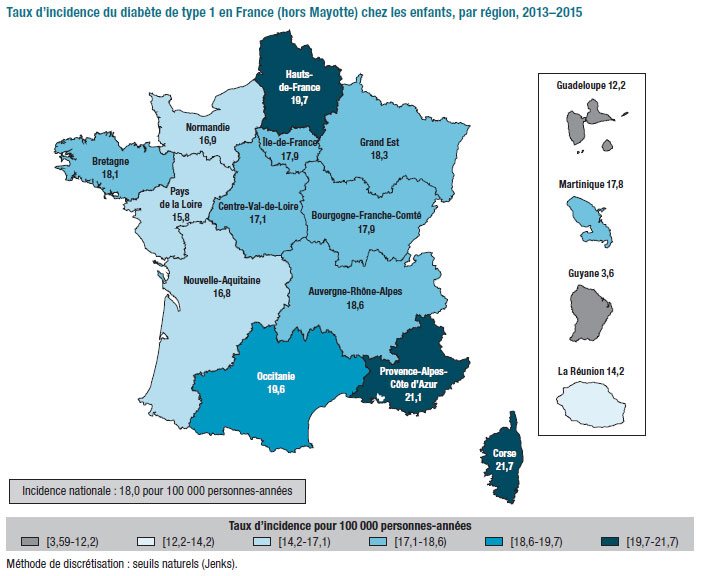
An annual incidence rate of type 1 diabetes of 18 per 100,000 children aged 0–15 over the 2013–2015 period
A disease that affects boys slightly more than girls
The number of new cases increases with age and is highest among 10- to 15-year-olds
Significant regional variations (see map)
Prevalence of all types of diabetes in France, 2015
The prevalence of pharmacologically treated diabetes continues to rise, reaching 5% of the French population in 2015, or 3.3 million people
Prevalence rates remain higher in the overseas departments, Hauts-de-France, and Seine-Saint-Denis
The most disadvantaged people are the hardest hit
In 2015, more than one in five men aged 70 to 84 had diabetes
Learn more:
World Diabetes Day. Special Issue. Bull Epidémiol Hebd 2017;27-28.
* Ketoacidosis is a serious complication of diabetes that can lead to coma. It occurs when the body no longer has enough insulin, and the blood becomes too acidic due to the presence of acetone.