

Summary of the Results of Studies on the Impact of the COVID-19 Pandemic on Mental Health, Substance Use Disorders, and Sleep Disorders Among the Working Population
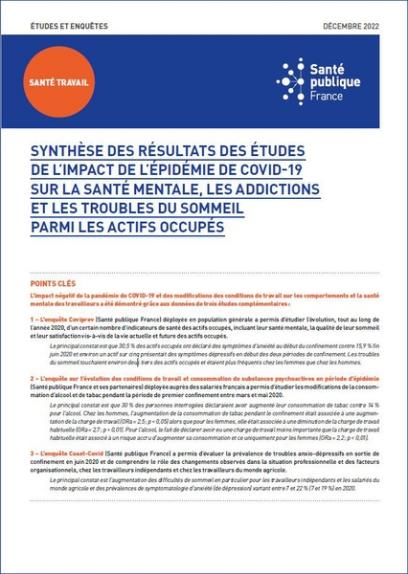
The negative impact of the COVID-19 pandemic and changes in working conditions on workers’ behavior and mental health has been demonstrated using data from three complementary studies:1 - The Coviprev survey (Santé publique France), conducted among the general population, tracked changes throughout 2020 in a number of health indicators for employed workers, including their mental health, the quality of their sleep, and their satisfaction with their current and future lives.The main finding is that 30.5% of employed workers reported symptoms of anxiety at the start of the lockdown, compared to 15.9% at the end of June 2020, and approximately one in five employed workers exhibited symptoms of depression at the start of both lockdown periods. Sleep disorders affected about two-thirds of employed workers and were more common among women than men.2 - The survey on changes in working conditions and psychoactive substance use during the pandemic (Santé publique France and its partners), conducted among French employees, examined changes in alcohol and tobacco use during the first lockdown period between March and May 2020.The main finding was that 30% of respondents reported an increase in tobacco use, compared with 14% for alcohol. Among men, increased tobacco use during lockdown was associated with an increased workload (ORa = 2.5; p < 0.05), whereas for women, it was associated with a decrease in their usual workload (ORa = 2.7; p < 0.01). For alcohol, reporting a lighter workload than usual was associated with an increased risk of increased consumption, but only among women (ORa = 2.2; p < 0.01).3 - The Coset-Covid survey (Santé publique France) assessed the prevalence of anxiety and depressive disorders following the end of lockdown in June 2020 and examined the role of observed changes in employment status and organizational factors among self-employed individuals and agricultural workers. The main finding was an increase in sleep difficulties, particularly among self-employed workers and agricultural workers, and a prevalence of anxiety (and depression) symptoms ranging from 7 to 22% (7 to 19%) in 2020.
Author(s): Lesage Alexandre, Chan Chee Christine, Geoffroy-Perez Béatrice, Marchand Jean-Luc, Le Barbier Mélina, Ménard Céline, Hocine Mounia
Publishing year: 2023
Pages: 22 p.
Collection: Studies and Surveys
In relation to
Our latest news

news
Growing Up with Screens. A special report in *La Santé en action* No. 474,...

news
Seniors, pregnant women, and nursing home staff: What is the status of their...

news