Contraception: Where Do We Stand?
CP_contraception_250921.pdf
Download (PDF - 336.92 KB)
Press Contacts
ANSM
Aude Rodriguez – 01 55 87 30 22 – presse@ansm.sante.fr
Santé publique France
presse@santepubliquefrance.fr
Vanessa Lemoine: 01 55 12 53 36
Stéphanie Champion: 01 41 79 67 48
To mark World Contraception Day on September 26, Santé publique France and the ANSM are reminding people of the importance of choosing a contraceptive method that fits their lifestyle.
Preference for first- and second-generation pills, use of IUDs—the latest sales data published by the French National Agency for Medicines and Health Products Safety (ANSM) show continuing trends in contraceptive use in France.
Focus on birth control pills
According to sales data, the shift in prescriptions from third- and fourth-generation birth control pills to first- and second-generation pills, which began in 2013, has continued. Since 2018, the distribution of use between third- and fourth-generation birth control pills and first- and second-generation pills has stabilized. It now stands at 14% and 86%, respectively, of all combined oral contraceptives (COCs) sold.
The latest sales data confirm that women and prescribers prefer contraceptive pills with the lowest risk of venous thromboembolism (phlebitis, pulmonary embolism)—specifically, first- or second-generation oral contraceptives containing levonorgestrel combined with a low dose of estrogen (20 μg).
Furthermore, sales of oral contraceptives (progestin-only or combined with estrogen) have been steadily declining over the past 10 years (approximately -12%); more specifically, the decline in combined oral contraceptives is about 33%, while the share of progestin-only contraceptives is increasing.
What about other contraceptive methods?
Regarding other hormonal methods, such as levonorgestrel-releasing intrauterine devices (IUDs) (Mirena, Jaydess, and Kyleena) and etonogestrel implants (Nexplanon), sales figures have remained stable over the past 10 years.
Furthermore, sales of copper IUDs have been rising sharply over the past decade, with sales doubling during this period.
It should also be noted that sales of vaginal rings (Etoring, NuvaRing) have declined over the past decade, with a drop of approximately 50%.
These sales trends align with the findings of the 2016 Health Barometer by Santé publique France, which highlighted a shift away from the pill toward other methods since 2013.
Reliable and detailed information on contraceptive methods: Questionsexualité.fr
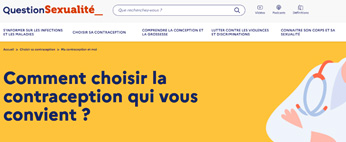
All contraceptive methods available in France are presented on the Questionsexualité.fr website, in the “Choosing Your Contraception” section, created by Santé publique France. The site outlines the advantages, disadvantages, methods of use, and practical information to help everyone make an informed choice from the available options.
A summary table allows users to see at a glance the effectiveness of the different methods and to rank them according to various criteria. To go further and prepare for a contraception consultation, the Questionsexualité.fr website also offers a personalized questionnaire. This questionnaire aims to:
promote dialogue between the patient and their healthcare provider, including on non-medical aspects;
provide personalized information on the various existing contraceptive methods and how well they align with each individual’s expectations.
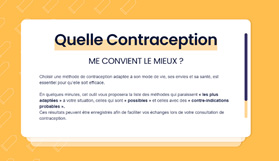
At the end of the questionnaire, a personalized response is provided, and for each contraceptive method, the pros and cons are explained in detail.
A link to the description of each method is available.
The results can be downloaded for free. This resource can be used to initiate a conversation with your healthcare provider during a consultation.
Questionsexualite.fr complements Santé publique France’s digital ecosystem for sexual health (Onsexprime.fr and Sexosafe.fr).
Through its various initiatives, Santé publique France seeks to provide information tailored to everyone’s needs. In the field of contraception, this involves promoting contraceptive diversity and disseminating reliable, accessible information so that everyone can make an informed choice.
Sexuality
A website that provides answers to questions about sexuality, anatomy, sexual practices, pregnancy, STIs, and discrimination based on sexual orientation.

Sexual health
thematic dossier
Santé publique France focuses in particular on four areas of sexual health: sexually transmitted infections, including HIV; contraception; combating discrimination; and violence.
Our latest news

news
Growing Up with Screens. A special report in *La Santé en action* No. 474,...

news
Seniors, pregnant women, and nursing home staff: What is the status of their...

news