
Press Release from ARS Grand Est - Santé publique France
CP_variants covid Grand Est_120221.pdf
Download (PDF - 292.85 KB)
Press Contacts
Santé publique France
presse@santepubliquefrance.fr
Stéphanie Champion: 01 41 79 67 48
Marie Delibéros: 01 41 79 69 61
Camille Le Hyaric: 01 41 79 68 64
COVID-19: Monitoring of COVID-19 variants in the Grand-Est region: a concerning level of circulation in Moselle and variants under surveillance in Meurthe-et-Moselle and Haut-Rhin.
The rollout in the region’s clinical laboratories of so-called “screening” RT-PCR tests capable of detecting the new variant known as the “British” variant (20I/501Y.V1, UK) and the new variants known as the “South African” (20H/501Y.V2, ZA) and “Brazilian” (20J/501Y.V3, BR) variants, continues
.
Surveillance of the viral circulation of SARS-CoV-2 variants is now conducted, on the one hand, through flash surveys carried out by Santé publique France, the National Reference Center (CNR) for Acute Respiratory Infections and a network of volunteer clinical laboratories—both hospital-based and community-based—from various regions, including the Grand Est region; and secondly, through the results of screening tests performed by clinical laboratories, which are entered into the screening system (SIDEP). Since mid-May 2020, this system has enabled monitor viral circulation.
Preliminary results from the second FLASH survey, conducted on January 27 and now available for a sample of positive specimens from six CLS in the Grand Est region, confirm that as of that date:
14.2% of new SARS-CoV-2 infections diagnosed by participating medical biology laboratories in the Grand Est region corresponded to a suspected 20I/501Y.V1 (UK) variant. These suspected cases are currently undergoing genotyping for confirmation.
23.7% of new SARS-CoV-2 infections analyzed through screening corresponded to one of the three variants of interest (UK, ZA, and BR). These samples are now also undergoing genotyping for confirmation.
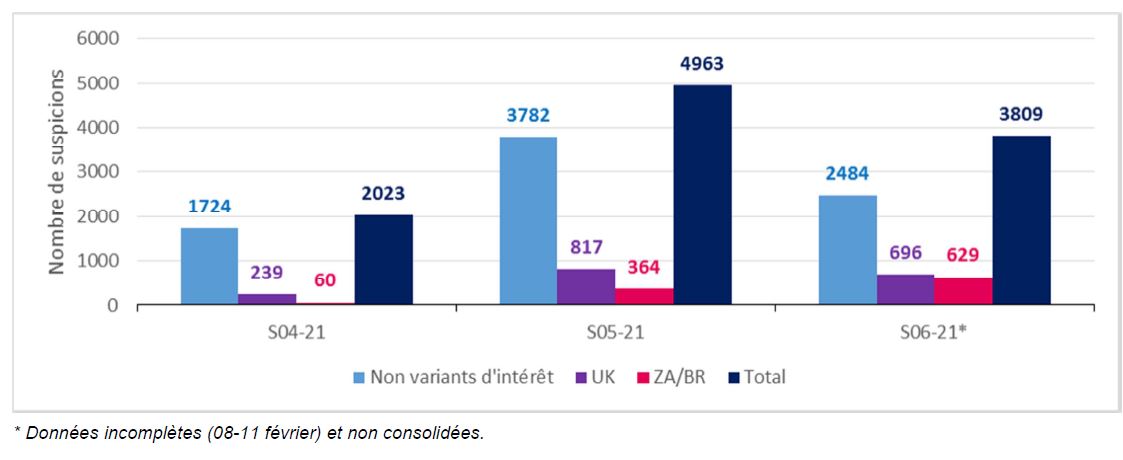
Furthermore, as of February 12, based on results reported by medical biology laboratories in the Grand Est region, Santé publique France recorded 10,831 screening tests, of which 3,809 corresponded to samples collected since the beginning of the week (Figure). Among these, the breakdown is as follows:
1,755 correspond to suspected 20I/501Y.V1 (UK) variants - (16.2%)
1,053 correspond to suspected variants 20H/501Y.V2 (ZA) or 20J/501Y.V3 (BR) - (9.7%)
Figure: Weekly trend in the number of people who have undergone screening and the number of tests corresponding to suspected variants (UK and ZA/BR). Grand Est (source: SIDEP, data extracted on 02/12/21)
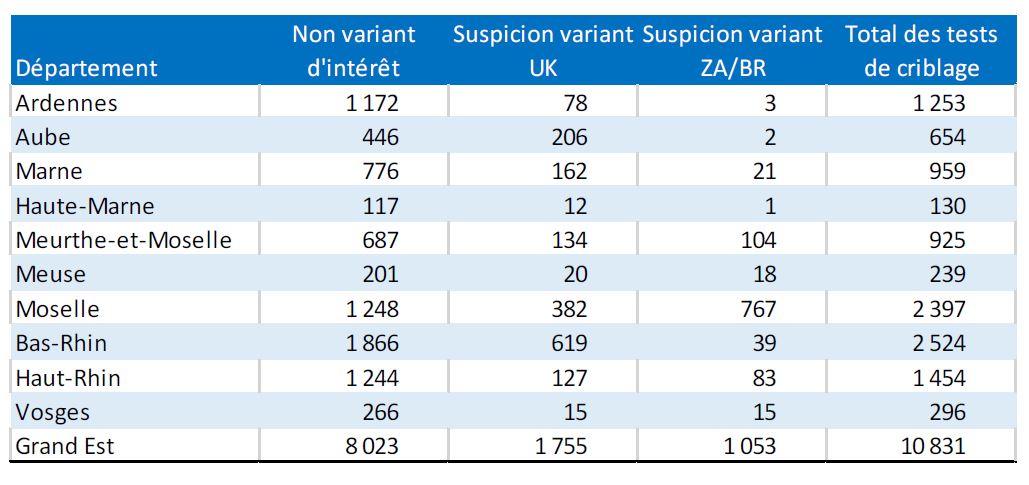
The geographic distribution of these suspected variants reveals a concerning circulation of the ZA/BR variant in the Moselle department (767 suspected cases), and to a lesser extent—though screening techniques have been deployed there more recently—in Meurthe-et-Moselle (104 suspected cases) and Haut-Rhin (83 suspected cases).
Table: Number of screening tests performed and number of suspected UK and ZA/BR variants by department. Grand Est (source: SIDEP, data extracted on 02/12/21)
Please be reminded that, regardless of the viral strain (whether the so-called “wild-type” strain or new variants), it is essential to:
strictly follow preventive measures and social distancing guidelines to limit the risk of transmission,
isolate yourself and get tested immediately if you have symptoms of COVID-19,
complete the isolation period if you test positive,
comply with the quarantine period if identified as a high-risk contact of a confirmed COVID-19 case,
strictly adhere to preventive measures and social distancing at all times to limit the risk of transmission.
The virus is still circulating; it is dangerous to us and our loved ones, particularly as new variants of the virus emerge. Even if vaccinated, it is important to remain vigilant and follow preventive measures.
Stay informed about the COVID-19 pandemic in France and around the world
Updates, Q&As, expert interviews... everything you need to know about the novel coronavirus (SARS-CoV-2) and COVID-19 in France and around the world
Our latest news

news
Growing Up with Screens. A special report in *La Santé en action* No. 474,...

news
Seniors, pregnant women, and nursing home staff: What is the status of their...

news