


Tiger mosquitoes infected with the dengue virus have been detected for the first time in mainland France
cp_detection_dengue_hexagone_20240916.pdf
Download (PDF - 342.72 KB)
Contacts
INRAE
Press Contacts INRAE Media
and Public Affairs Department: 01 42 75 91 86
presse@inrae.fr
Santé publique France
presse@santepubliquefrance.fr
Stéphanie Champion: 01 41 79 67 48
Camille Le Hyaric: 01 41 79 68 64
Scientific
contact Dr. Vincent Raquin
vincent.raquin@ephe.psl.eu Joint Research
Unit “Viral Infections and Comparative Pathology” (IVPC–INRAE/Claude Bernard University of Lyon 1/EPHE); BUNYA team, Animal
Health (SA) Scientific Department, INRAE
Lyon-Grenoble-Auvergne-Rhône-Alpes Center
Dengue fever—or tropical fever—is the leading mosquito-borne viral disease for which there is no specific treatment. Prevention is therefore essential. Although historically confined to the intertropical zone, human infections with the dengue virus have been detected in mainland France since 2010. Scientists from INRAE, in collaboration with Claude Bernard Lyon 1 University, EPHE-PSL, and the MASCARA1 network, investigated an outbreak of dengue cases detected in the Drôme region in 2023. For the first time in mainland France, the researchers found mosquitoes infected with the virus.
This discovery is significant because it not only confirms the vector species (in this case, the tiger mosquito), but also offers an innovative way to track the virus and monitor the epidemiology of the disease easily, quickly, and at low cost, by analyzing the contents of mosquito traps set up by residents living near detected cases of the disease.
The virus responsible for dengue fever belongs to the Orthoflavivirus genus, like the Zika virus and the West Nile virus. While human infections with the dengue virus have been detected in mainland France since 2010, data needed to identify the mosquito species involved and track the virus have been lacking. Supported by the local MASCARA network, which includes public health agencies and research laboratories, INRAE researchers and their colleagues analyzed, in late summer 2023, mosquitoes collected from private traps in a French urban neighborhood affected by a dengue outbreak.
The outbreak, in the Drôme region, included 3 cases, 2 of which were confirmed as locally acquired (via serology or viral detection), meaning that the patients had not traveled to an area where the disease is present in the past 15 days and had therefore been infected within France. A third case, identified near the first two following the epidemiological investigation, was classified as imported. The individual had returned from a recent trip to the French Caribbean islands with symptoms consistent with dengue, but the disease had not been diagnosed.
Aedes albopictus (tiger) mosquitoes trapped within 100 meters of the infected individuals’ residences were found to carry the virus. Genetic data from the virus obtained from the collected mosquitoes linked this viral strain to the strains responsible for the 2023–2024 dengue epidemic that ravaged the French Caribbean islands. This suggests that mosquitoes transmitted the virus from the imported case to the locally acquired cases, causing the outbreak.
This study indicates that the virus circulates in mainland France via local populations of the tiger mosquito. It highlights the importance of implementing individual and collective control measures targeting this species, as well as raising awareness among healthcare professionals about mosquito-borne diseases. Finally, it highlights the value of entomological and virological surveillance, particularly through the use of private mosquito traps.
Since when have autochthonous cases of dengue been observed in France?
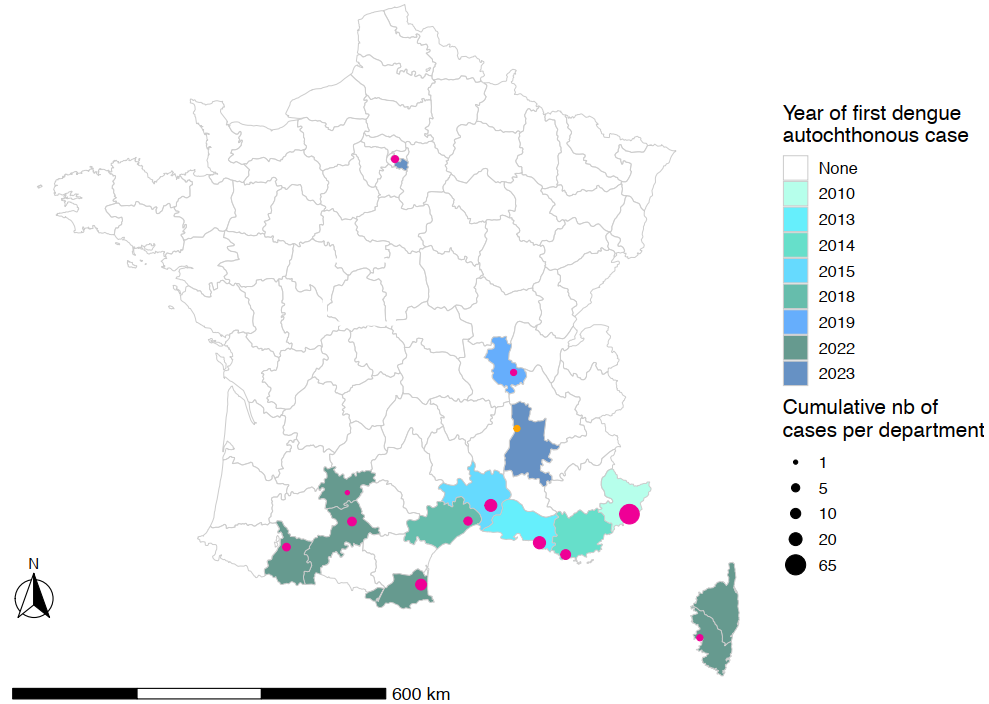
In mainland France, autochthonous dengue infections—that is, infections affecting people who had not traveled in the past 15 days to an area where the disease is present—were initially detected in Nice and remained limited to the south of the country until 2018. Since then, the epidemiological profile of dengue has changed. In 2022 alone, 65 locally acquired cases were identified, and this total exceeds the cumulative number of cases reported over the previous 10 years. Furthermore, the latitudinal boundary of dengue clusters observed in metropolitan France has shifted northward, first to the Auvergne-Rhône-Alpes region in 2019 and then to Île-de-France in 2023.
For each department in metropolitan France, the map below shows the year of the first detection of locally acquired dengue and the cumulative number of cases (through 2023).
1 The MASCARA network (Mosquitoes and Arboviruses: Surveillance and Collective Action in Auvergne-Rhône-Alpes) comprises Santé Publique France, the Auvergne-Rhône-Alpes Regional Health Agency, the Rhône-Alpes Interdepartmental Agreement for Mosquito Control, ANSES, and the National Reference Center for Arboviruses.
2 Official resource platform on the tiger mosquito in Auvergne-Rhône-Alpes
Reference:
Viginier B., Klitting R., Galon C. et al. (2024). Peri-domestic entomological surveillance using private traps allows detection of dengue virus in Aedes albopictus during an autochthonous transmission event in mainland France, late summer 2023. Euro Surveill. 29(36):pii=2400195

Dengue
thematic dossier
Dengue fever is a viral disease transmitted by mosquitoes of the genus Aedes. The most common symptoms are fever and joint pain. Its complications can be severe.
Our latest news

news
SIBCA 2026: The UrBaCS network presents its solutions for cities and...

news
Physical Activity and Combating a Sedentary Lifestyle: How Does Santé...
news