Download




Learn all about the process used to assess the health impact and the ongoing work of the Post-Fire Health 76 initiative
Everything you need to know about the industrial fire on September 26, 2019, in Rouen and the response by Santé publique France
The fire that occurred on September 26, 2019, at the Lubrizol and NL Logistique sites in Rouen was a significant event due to its location, its scale, the quantities and types of substances burned, and the hazardous agents it released into the environment. The potential consequences for human health of such an industrial accident justified the implementation of epidemiological studies to investigate and assess its health impact.
Many residents of Rouen and the Seine-Maritime department (76), as well as workers, were potentially exposed to a wide range of hazards capable of affecting their health in various ways:
the sight of flames, the plume of smoke, and soot deposits,
the perception of unpleasant and foul odors,
fear of a life-threatening situation,
asbestos fibers and fiber-cement debris scattered around the factory,
chemical substances dispersed into the air and deposited in the environment,
a sense of uncertainty related to the accident, its consequences, and its management in the days that followed.
Santé publique France was commissioned by the Directorate General for Health to assess the medium- and long-term health impact of the industrial accident on individuals who may have been exposed to one or more of these health risk factors. The description and analysis of their perceptions of the event, their exposures, and the symptoms they experienced, along with the measurement and monitoring of indicators of the population’s health status, will enable public authorities to implement public health measures if necessary and to better adapt the future management of other industrial accidents.
In this context, the Post-Fire Health 76 (SPI 76) initiative has been deployed and includes a series of epidemiological studies, either completed or ongoing, to assess the health impact of the fire.
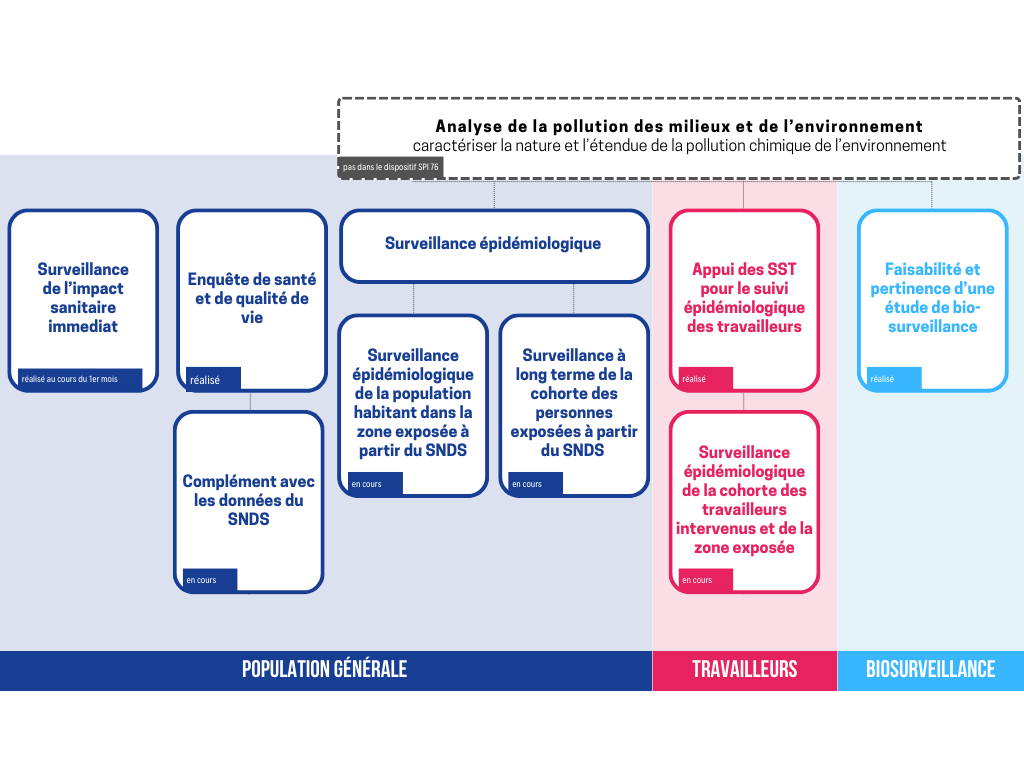
To assess the health impact of this fire over a period ranging from the days immediately following the fire to several decades later, the SPI 76 initiative comprises four complementary epidemiological components:
A health and quality of life study titled “A Study Listening to Your Health” was conducted in 2020 on a representative sample of 4,000 adults and 1,200 children living in the Seine-Maritime municipalities affected by the accident. It focused on perceived exposures, symptoms, and health issues experienced, access to information during the event, as well as the health and quality of life of the respondents at the time of the study. A supplementary questionnaire on mental health administered to volunteers provided a more detailed description of the accident’s impact on the mental health of those exposed. In a second phase, healthcare reimbursement data from the National Health Data System (SNDS) for randomly selected individuals were extracted and matched with survey data to address selection bias and supplement the results.
Regular epidemiological monitoring, over several years, of health indicators such as the prevalence of chronic diseases, certain cancers, and pregnancy outcomes. It covers the entire population of the municipalities in Seine-Maritime affected by the accident and will be conducted using information available in the SNDS, which records drug reimbursements by the National Health Insurance, medical consultations and other care, causes of hospitalization, deaths, etc. This surveillance comprises two distinct components:
epidemiological surveillance of the population living in the exposed area (ecological study). The aim is to describe the incidence of health events within the exposed area over time and to compare it with reference rates, in order to identify any increase in this incidence following the fire;
epidemiological surveillance of the exposed population cohort (exposed/unexposed cohort study), i.e., the prospective longitudinal follow-up of the population residing in the area exposed to the fire at the time of the accident, regardless of their subsequent places of residence.
Support for the Occupational Health and Safety Services (SPST) to monitor the health of employees at the two affected industrial sites, professionals who responded to the accident, and employees of other companies who were exposed. The Occupational Health Alert Group (GAST) assessed the need for, and where appropriate proposed, a monitoring strategy for workers exposed to emissions from the fire in order to evaluate the health consequences of the event over time.
The detection and measurement, within the bodies of exposed individuals, of chemical substances dispersed by the fire. This type of study, known as an exposure assessment or biomonitoring study, can be conducted particularly if the results of environmental analyses show that it is feasible and relevant to measure biomarkers of exposure in blood, urine, or hair. A feasibility study was therefore conducted beforehand.
The teams at Santé publique France receive guidance from a Thematic Support Committee dedicated to the SPI 76 studies. Established in March 2020, it is composed of specialists in the scientific disciplines and fields relevant to the studies being conducted: toxicology, metrology, epidemiology, occupational pathology, perceived health and psychometrics, and sociology. These qualified experts are external to Santé publique France and work at the CNRS, Inserm, universities, or hospitals.
This independent scientific committee, titled “Assessment of the Impact of the Lubrizol and NL Logistique Fires on Public Health,” is tasked with guiding methodological choices and the interpretation of data from the four components of the Post-Fire Health 76 study program, and with helping to propose public health actions based on their findings.
Santé publique France bases its work on a participatory approach that is closely aligned with on-the-ground realities. By promoting consultation and collaborative planning with representatives of those directly affected by the industrial accident, the goal is to improve the quality and relevance of the health and quality-of-life survey, adapting it to the local context and addressing the concerns and needs expressed by the population as effectively as possible.
A Health Group was established in Rouen in January 2020 by Santé publique France under the coordination of Marcel Calvez, a professor of sociology at the University of Rennes, who has conducted research on scientist-citizen relations involving environmental health issues.
Download
The Health Group was formed following a call for volunteers issued in December 2019 by the Transparency and Dialogue Committee. It was composed of 19 local stakeholders:
members of nonprofit organizations: Rouen Respire, UFC Que Choisir – Rouen, France Assos Santé (Ligue Contre le Cancer 76, Réseau Environnement Santé);
healthcare professionals: representatives of the Order of Physicians and the Order of Nurses, the Regional Union of Private Practitioners of Seine-Maritime, physicians from the Occupational Pathology Consultation Center and the Pulmonology Department (Rouen University Hospital);
elected officials and representatives of local authorities: mayors of Canteleu, Petit-Quevilly, La-Rue-Saint-Pierre, Rouen Métropole Normandie, vice-president of the Normandy Region, members of parliament from the 2nd constituency (East and North) and the 10th constituency (North);
a professor of anthropology at the University of Rouen.
This group was involved in all phases of the health and quality of life study: development of the protocol and questionnaire, definition of the study area, and interpretation of the results. Its members were regularly consulted on informational materials related to this study. This group also had the opportunity to discuss with the teams the methodology and the selection of health indicators to be monitored as part of general population surveillance.
The Health Group was dissolved on December 10, 2021, upon the dissolution of the Transparency and Dialogue Committee.
List of Health Group members
From October 2019 to December 2021, the Transparency and Dialogue Committee (CTD) brought together all stakeholders affected by the consequences of the industrial accident: residents, elected officials, industrialists, environmental organizations, representatives of the agricultural sector, professional and labor organizations, economic stakeholders, government agencies, and health services, among others. Chaired by the Prefect of Seine-Maritime, this committee was tasked with monitoring all issues related to the consequences of this industrial disaster over the long term and sharing all available information. It was dissolved following its final meeting on December 10, 2021.
The validity and interpretation of the study results were discussed with members of the Thematic Support Committee to identify key lessons and conclusions. The significance of the results of the studies conducted in 2019–2021 and their relevance to locally raised questions were also shared with the Health Group.
The results of the various SPI 76 studies conducted in 2019–2021 were presented at meetings of the Transparency and Dialogue Committee and made public to the study participants, mayors, healthcare professionals, and the population affected by the studies. Following the prefecture’s decision to dissolve this committee in December 2021, the upcoming results will be communicated to the various local authorities.
The main findings of the studies conducted and links to more comprehensive documents are as follows:
The initial monitoring of the immediate health impact of the fire shows that at the time of the accident and during the following month, there were few visits to emergency care, and these were primarily due to minor, irritative symptoms (pulmonary and otolaryngological [ENT]: cough, breathing difficulties, irritation and sore throat, tingling in the nose, etc.), gastrointestinal issues (nausea, vomiting, abdominal pain), and headaches.
According to the health and quality of life survey conducted one year later, “A Study Listening to Your Health”:
66% of respondents living in the exposed area reported at least one health issue—whether or not it led to seeking medical care—attributed to the fire; these were primarily psychological symptoms (stress, anxiety, etc.), ENT symptoms, general symptoms, eye symptoms, respiratory symptoms, and sleep disorders;
this fire had a negative effect on residents’ perceived health, still measurable one year later, particularly on mental health;
The supplementary study also demonstrates the impact of the incident on the mental health (post-traumatic stress disorder, generalized anxiety, and depression) of populations living in the exposed area, particularly near the fire;
these results also highlight factors traditionally associated with these psychological disorders, such as social isolation, economic deprivation, or a history of mental health issues;
They confirm the importance of providing appropriate support to people living near the site of the incident, as well as to those who are economically disadvantaged, socially isolated, or have a history of mental health issues, in the event of future industrial accidents.
Based on the analysis of available environmental data, conducting a biomonitoring study aimed at assessing overexposure related to the fire does not appear relevant. Such a study would not be likely to provide useful additional information for measures to reduce public exposure beyond those implemented in the aftermath of the fire.
Regarding workers, the main findings of the GAST’s work show that certain categories of workers were exposed to pollution emitted by the fire and that the effects observed during medical follow-up by the SPSTs were similar to those in the general population. The GAST proposed:
to record the exposure conditions in medical records;
to conduct epidemiological monitoring, as for the general population, in addition to medical monitoring (study in progress);
to improve healthcare provision for workers in the event of an industrial accident.
Post-Fire Health 76 - Monitoring the health of workers following the fire in Rouen on 09/26/19 (report and summary)
Further results from the Post-Fire Health 76 initiative will be published at a later date, including the results of epidemiological surveillance of the general population exposed to the fire as well as the monitoring of exposed workers.
presse












