

Cancers in the Industrial Area South of Grenoble. Cancer Incidence and Cancer Mortality in the Municipalities Adjacent to the Pont-de-Claix and Jarrie Industrial Parks, 2003–2013
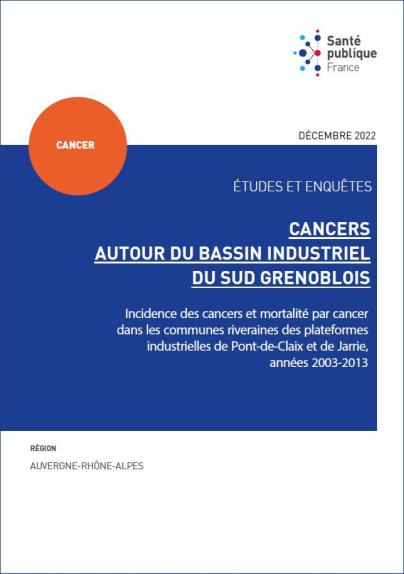
In 2020, the Auvergne-Rhône-Alpes Regional Health Agency asked Santé publique France to investigate potential excess cancer rates among residents living near the industrial complexes in Pont-de-Claix and Jarrie in the southern Grenoble area (Isère department). The study conducted by Santé publique France is an ecological study. It compares cancer incidence and cancer mortality rates in the municipalities neighboring the industrial sites of Pont-de-Claix and Jarrie with those observed in the Isère department. Mortality data, collected from Inserm’s CépiDC, and incidence data, collected from the Isère Cancer Registry, cover the period from 2003 to 2013. The SMR and SIR (standardized mortality and incidence ratios), obtained through indirect standardization, are analyzed across two study areas: an area comprising the four municipalities closest to the industrial site and an expanded area comprising eighteen municipalities. Across all cancer sites, the cancer situation in the municipalities adjacent to the Pont-de-Claix and Jarrie industrial platforms is very similar to that of the Isère department. Among men, incidence and mortality rates are entirely comparable to those of Isère in both the narrower and the broader zones. Among women, incidence is slightly higher than the departmental average (not statistically significant) and mortality slightly lower (not statistically significant). Analyses by location, however, show a significant excess of pleural mesotheliomas among men as well as women, particularly in the four municipalities closest to the site. All men and half of the women residing in the area who have pleural mesothelioma and who were able to be interviewed about their life history as part of the National Mesothelioma Surveillance Program (PNSM) report occupational exposure, most often at a company on the site. For some women, exposure was para-occupational (asbestos fibers brought home by a spouse). These results are consistent with the fact that asbestos is the primary recognized risk factor for mesothelioma and that exposure most often occurs in an occupational or para-occupational setting.
Author(s): Pépin Philippe, Yvon Jean-Marc
Publishing year: 2022
Pages: 25 p.
Collection: Monitoring data
In relation to
Our latest news

news
Call for Nominations for the Renewal of the Scientific Advisory Board of the...

news
Growing Up with Screens. A special report in *La Santé en action* No. 474,...

news