


Let’s protect ourselves from mosquitoes and the diseases they spread!
cp_surveillance_arboviroses_20260506.pdf
Download (PDF - 427.45 KB)
Press Contact
Ministry of Health, Families, Independence, and People with Disabilities:
alertes-presse@sante.gouv.fr
Public Health France:
presse@santepubliquefrance.fr
As it does every year, mainland France entered an enhanced surveillance period for arboviral diseases on May 1 (which will last until November 30). Faced with the growing threat of disease-carrying mosquitoes (dengue, chikungunya, Zika, West Nile virus), health authorities have made the fight against these diseases a public health priority. To curb the risk of local transmission, vector control measures are being implemented, along with targeted control measures.
An unprecedented year in 2025, underscoring the importance of individual and collective preventive measures
The year 2025 was marked by an unprecedented number of chikungunya cases recorded in mainland France, with 81 local transmission clusters and nearly 809 indigenous cases identified. This represents the highest number of cases and indigenous transmissions of chikungunya identified since the implementation of enhanced surveillance in 2006. Regarding imported cases in mainland France, their number is largely attributable to the epidemic that occurred in the Indian Ocean, particularly in Réunion.
Additionally, 30 autochthonous cases of dengue were identified in mainland France, and 60 confirmed cases of West Nile virus infection were recorded.
Finally, for the first time, certain regions reported locally acquired cases of chikungunya (Burgundy-Franche-Comté, Grand Est, and New Aquitaine) and West Nile virus (Ile-de-France, Auvergne-Rhône-Alpes, and Normandy) within their territories.
Healthcare professionals play an essential role in the surveillance of arboviruses in mainland France. This surveillance relies on the system for notifiable diseases (MSO) for imported or locally acquired cases documented through laboratory testing, for which the Cerfa forms have been digitized for the first time.
Download

bulletin national
6 May 2026
Chikungunya, Dengue, and Zika in Metropolitan France. 2025 Report.
Download
bulletin national
6 May 2026
West Nile Virus in Metropolitan France. 2025 Report.
Preventive measures are all the more essential given that the tiger mosquito is now established in 83 metropolitan departments
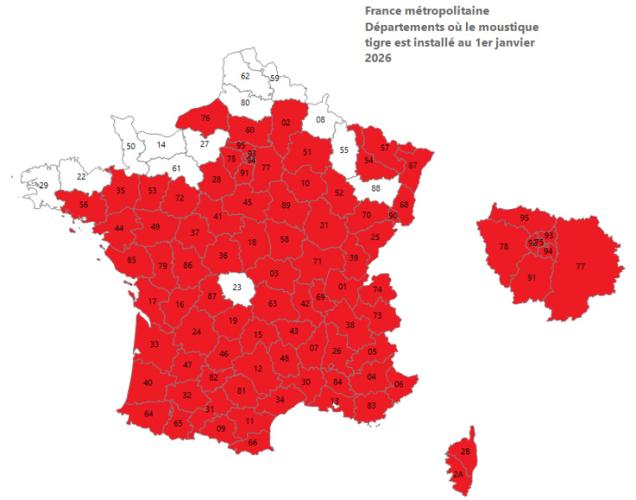
The tiger mosquito (Aedes albopictus), first detected in mainland France in 2004, continues to gain ground, increasing the risk of transmitting diseases that can sometimes be serious. As of January 1, 2026, it had colonized 83 of the 96 metropolitan departments. Active from May to November, this vector can transmit dengue, chikungunya, and Zika. In this context, increased public and healthcare professional engagement in individual prevention measures is essential to limit its spread.
Map of the Tiger Mosquito's Distribution in France
Prevention is everyone’s responsibility!
In the face of the proliferation of mosquitoes and the associated health risks, everyone can take daily steps to protect themselves and limit their spread:
- removing standing water (pots, tarps, gutters, etc.) helps limit the development of mosquito larvae;
- to avoid bites, it is advisable to take simple precautions: wear protective clothing, use repellents, and install mosquito nets (especially on strollers, windows, and doors).
By 2026, the risk of importation and spread to mainland France will increase. These diseases are actively circulating internationally—in the Americas, Southeast Asia, Africa, and the Pacific—and outbreaks are currently affecting France’s overseas territories. Travelers heading to these areas are urged to exercise heightened vigilance. Indeed, a person infected while traveling in a high-risk area may, upon their return, transmit the virus to a mosquito, which in turn may infect others. These new locally acquired cases could thus trigger an epidemic in mainland France.
Get informed before you leave, protect yourself from bites during your stay and for up to three weeks after your return. See a doctor immediately if you experience symptoms (fever, pain, rashes), and be sure to mention your travel history.
Learn more
- Summary of surveillance of dengue, chikungunya, and Zika in mainland France in 2025 in high-risk areas and countries:
- Visit the travel advice pages on the France Diplomatie website or those of the Pasteur Institute in Lille.
- For overseas territories, visit the website of the relevant Regional Health Agency (ARS).
- Mosquitoes that transmit diseases
- Dengue, Chikungunya, Zika: From Prevention to Reporting
- For overseas territories, visit the website of the relevant Regional Health Agency (ARS).

Chikungunya
thematic dossier
Chikungunya is a viral disease transmitted by mosquitoes of the genus Aedes. The most common symptoms are fever and joint pain.

Dengue
thematic dossier
Dengue fever is a viral disease transmitted by mosquitoes of the genus Aedes. The most common symptoms are fever and joint pain. Its complications can be severe.

Zika
thematic dossier
Zika is a viral disease transmitted primarily by mosquitoes but also through sexual contact. Symptoms are usually mild, but the virus can cause birth defects if a woman becomes infected during...
Our latest news

news
Growing Up with Screens. A special report in *La Santé en action* No. 474,...

news
Seniors, pregnant women, and nursing home staff: What is the status of their...

news












