


Parkinson's disease: Cases have doubled in 25 years
In France, more than one million people are affected by a neurodegenerative disease. To mark World Parkinson’s Day, Santé publique France highlights the significance of this disease in a special issue of its weekly epidemiological bulletin dedicated to this topic and publishes the first study on the prevalence of Parkinson’s disease that covers the entire country and multiple health insurance plans.
Parkinson's disease: a significant burden on families, society, and the economy
Neurological diseases are currently the leading cause of disability and the second leading cause of death worldwide. Among them, Parkinson’s disease saw the largest increase in cases between 1990 and 2015: the number more than doubled. This increase is largely attributed to population aging and the growing number of older adults.
Data published by Santé publique France contribute to a better understanding of the burden of Parkinson’s disease in France.
Documents published on the occasion of World Parkinson’s Day, April 11, 2018
Report on the prevalence of Parkinson’s disease in France, national and regional data 2010–2015
Report on mortality related to Parkinsonian syndromes based on death certificates, 2000–2010
Updated epidemiological data on Parkinson's disease
Key figures and findings
Prevalence of Parkinson's disease in France in 2015 and projections through 2030
First study on Parkinson’s disease covering the entire French territory (including overseas territories).
At the end of 2015, 160,000 Parkinson’s patients were receiving treatment, with approximately 25,000 new cases per year; 17% of new cases were under the age of 65.
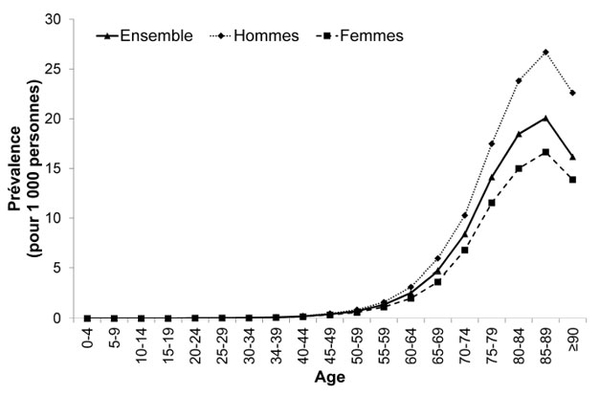
Men are affected 1.5 times more often than women.
Significant increase in the number of cases due to an aging population and improved life expectancy.
By 2030, the number of Parkinson’s patients could increase by 56%, with 1 in 120 people over the age of 45 affected by the disease.
Prevalence of Parkinson’s disease in France in 2015 by age and sex
Mortality and causes of death in Parkinson’s disease: analysis of death certificates in France, 2000–2014
Of the 527,423 deaths among individuals aged 50 and older in 2014, 1.8% cited Parkinson’s disease (9,638 deaths).
People who died from Parkinson’s disease were, on average, older than those who did not die from the disease (84 years vs. 80 years), less often women, more often married, and twice as likely to die in a nursing home.
Parkinson’s disease is identified as the underlying cause of death in more than half of all cases.
Falls, Alzheimer’s disease, and aspiration pneumonia are the causes of death most strongly associated with Parkinson’s disease.
All results derived from death certificates should be interpreted with caution due to underreporting of Parkinson’s disease in these certificates.
Mortality in a cohort of incident cases of Parkinson’s disease identified in medical-administrative databases
For the first time in France, it is possible to accurately describe, using recent data, the survival and mortality indicators associated with Parkinson’s disease by sex and age group.
Of the 131,418 incident cases followed, 31,670 subjects died (i.e., nearly 1 in 4). The median age at death is 83.3 years.
The 5-year survival probability is 62% for men and 68% for women. More than 90% of deaths occur after age 70.
Mortality among Parkinson’s patients remains higher than that of the general population. The risk of death is twice as high as in healthy individuals of comparable age and sex, with a significant impact on younger people and women.
Incidence of Parkinson’s disease among farmers and in the general population based on agricultural characteristics of French cantons (2010–2012)
France is among the countries that use the most pesticides in the world, and approximately 90% are used in agriculture.
To date, no study has assessed the excess risk of Parkinson’s disease among the French agricultural population, and few studies have examined the role of non-occupational exposure in the general population.
The incidence of Parkinson’s disease is higher among farmers than in the general population (+13%): - +10% in the viticulture sector compared to other agricultural sectors - incidence increases with the size of agricultural land
These results justify increased surveillance of the disease among farmers and further studies on the role of non-occupational pesticide exposure in the general population.
Overview of the disease
Parkinson's disease is a chronic, slowly progressive condition characterized by motor symptoms (resting tremor, slowness and difficulty of movement or bradykinesia, muscle rigidity, balance disorders) associated with variable non-motor symptoms (such as constipation, fatigue, depression and anxiety, sleep disorders, olfactory disorders, cognitive impairments). It is the most common cause of Parkinsonian syndromes. Age is the primary risk factor for the disease. Rare before the age of 50, its prevalence increases sharply with aging. The average age at diagnosis is around 75–80 years.
Santé publique France’s Contribution to the Neurodegenerative Diseases Plan
The Ministry of Health’s 2014–2019 Plan for Neurodegenerative Diseases aims to continue and strengthen national efforts regarding these diseases, particularly regarding access to care and support for patients and their caregivers, as well as the development and better coordination of research.
There is still limited information available in France to assess the burden of neurodegenerative diseases at the national level, both in terms of prevalence and healthcare utilization. Through its epidemiological surveillance program, Santé publique France helps generate this information and participates in several initiatives under the government plan.
Since 2014, Santé publique France has developed a surveillance program for neurodegenerative diseases (Parkinson’s disease, motor neuron diseases, Alzheimer’s disease, and related disorders) in collaboration with the National Institute of Health and Medical Research (Inserm) (U1018-CESP “Epidemiology of Aging and Age-Related Diseases” team).