


Data
The Heat Wave and Health Alert System (SACS), established by Santé publique France, is used to study the health impact of heat waves.
Status Update During an Alert
During a heat wave alert, Santé publique France analyzes city emergency service data (SOS Médecins) and hospital emergency department data on a daily basis. Three weeks after the end of each heat wave, Santé publique France publishes an epidemiological report including an initial estimate of the excess all-cause mortality observed during the heat wave. Once the alert has ended, Santé publique France prepares a summary of the heat wave.
At the national level
- Heat Waves and Health in France. Bulletin of August 19, 2026.
- Heat Waves and Health: Excess Mortality During the Heat Wave from July 3 to 22, 2026
- Heat Waves and Health in France. Bulletin of August 12, 2026.
- Heat Waves and Health in France. Bulletin of August 5, 2026.
- Heat Waves and Health in France. Bulletin of July 29, 2026.
- Heat Waves and Health in France. Bulletin of July 22, 2026.
- Heat Waves and Health: Excess Mortality During the Heat Wave from June 17 to July 2, 2026
- Heat Waves and Health in France. Bulletin of July 16, 2026.
- Heat Waves and Health in France. Bulletin of July 8, 2026.
- Heat Waves and Health in France. Bulletin of July 3, 2026.
- Heat Waves and Health in France. Bulletin of June 24, 2026.
- Heat Waves and Health: Excess Mortality During the Heat Wave of May 24–28, 2026
- Heat Waves and Health in France. Bulletin dated June 4, 2026.
By Region
View the heat wave and health bulletins for your region related to the summer 2026 heat wave.
- Auvergne-Rhône-Alpes:
- Heat Waves and Health in Auvergne-Rhône-Alpes. Bulletin dated August 19, 2026.
- Heat Waves and Health in Auvergne-Rhône-Alpes. Bulletin dated August 12, 2026.
- Heat Wave and Health in Auvergne-Rhône-Alpes. Bulletin dated August 5, 2026.
- Heat Waves and Health in Auvergne-Rhône-Alpes. Bulletin dated July 22, 2026.
- Heat Waves and Health in Auvergne-Rhône-Alpes. Bulletin dated July 15, 2026.
- Heat Waves and Health in Auvergne-Rhône-Alpes. Bulletin dated July 3, 2026.
- Heat Waves and Health in Auvergne-Rhône-Alpes. Bulletin dated June 23, 2026.
- Burgundy-Franche-Comté:
- Heat Waves and Health in Burgundy-Franche-Comté. Bulletin dated August 12, 2026.
- Heat Waves and Health in Burgundy-Franche-Comté. Bulletin dated August 5, 2026.
- Heat Waves and Health in Bourgogne-Franche-Comté. Bulletin dated July 30, 2026.
- Heat Waves and Health in Bourgogne-Franche-Comté. Bulletin dated July 15, 2026.
- Heat Waves and Health in Bourgogne-Franche-Comté. Bulletin dated July 8, 2026.
- Heat Waves and Health in Bourgogne-Franche-Comté. Bulletin dated June 23, 2026.
- Brittany:
- Heat Waves and Health in Brittany. Bulletin dated August 19, 2026.
- Heat Waves and Health in Brittany. Bulletin dated July 22, 2026.
- Heat Waves and Health in Brittany. Bulletin dated July 15, 2026.
- Heat Waves and Health in Brittany. Bulletin dated July 3, 2026.
- Heat Waves and Health in Brittany. Bulletin dated June 23, 2026.
- Heat Waves and Health in Brittany. Bulletin dated June 4, 2026.
- Centre-Val de Loire:
- Grand Est:
- Heat Waves and Health in the Grand Est Region. Bulletin dated August 19, 2026.
- Heat Waves and Health in the Grand Est Region. Bulletin dated July 22, 2026.
- Heat Waves and Health in the Grand Est Region. Bulletin dated July 16, 2026.
- Heat Waves and Health in the Grand Est Region. Bulletin dated July 3, 2026.
- Hauts-de-France:
- Heat Wave and Health in the Hauts-de-France region. Bulletin dated August 19, 2026.
- Heat Wave and Health in the Hauts-de-France Region. Bulletin dated July 22, 2026.
- Heat Waves and Health in the Hauts-de-France Region. Bulletin dated July 17, 2026.
- Heat Waves and Health in the Hauts-de-France Region. Bulletin dated July 3, 2026.
- Heat Waves and Health in Hauts-de-France. Bulletin dated June 23, 2026.
- Île-de-France:
- Heat Waves and Health in Île-de-France. Bulletin dated August 19, 2026.
- Heat Waves and Health in Île-de-France. Bulletin dated July 22, 2026.
- Heat Waves and Health in Île-de-France. Bulletin dated July 15, 2026.
- Heat Waves and Health in Île-de-France. Bulletin dated July 3, 2026.
- Heat Waves and Health in Île-de-France: Bulletin, June 23, 2026.
- Heat Waves and Health in Île-de-France. Bulletin of June 4, 2026.
- Nouvelle-Aquitaine:
- Heat Waves and Health in Nouvelle-Aquitaine. Bulletin dated August 19, 2026.
- Heat Waves and Health in Nouvelle-Aquitaine. Bulletin dated July 22, 2026.
- Heat Waves and Health in Nouvelle-Aquitaine. Bulletin, July 15, 2026.
- Heat Waves and Health in Nouvelle-Aquitaine. Bulletin dated July 8, 2026.
- Heat Waves and Health in Nouvelle-Aquitaine. Bulletin dated July 3, 2026.
- Heat Waves and Health in Nouvelle-Aquitaine. Bulletin dated June 23, 2026.
- Heat Waves and Health in Nouvelle-Aquitaine. Bulletin dated June 4, 2026
- Normandy:
- Heat Waves and Health in Normandy. Bulletin dated August 19, 2026.
- Heat Waves and Health in Normandy. Bulletin dated July 22, 2026.
- Heat Waves and Health in Normandy. Bulletin dated July 15, 2026.
- Heat Waves and Health in Normandy. Bulletin dated July 3, 2026.
- Heat Wave and Health in Normandy. Bulletin dated June 23, 2026.
- Heat Waves and Health in Normandy. Bulletin dated June 4, 2026.
- Pays-de-la-Loire:
- Heat Waves and Health in the Pays de la Loire. Bulletin dated August 19, 2026.
- Heat Waves and Health in the Pays de la Loire. Bulletin dated July 22, 2026.
- Heat Waves and Health in the Pays de la Loire. Bulletin dated July 16, 2026.
- Heat Waves and Health in the Pays de la Loire. Bulletin dated July 3, 2026.
- Heat Waves and Health in the Pays de la Loire. Bulletin dated June 23, 2026.
- Heat Waves and Health in the Pays de la Loire. Bulletin dated June 4, 2026.
- Occitanie:
- Heat Waves and Health in Occitanie. Bulletin of August 19, 2026.
- Heat Waves and Health in Occitanie. Bulletin dated August 12, 2026.
- Heat Waves and Health in Occitanie. Bulletin dated August 5, 2026.
- Heat Waves and Health in Occitanie. Bulletin dated July 30, 2026.
- Heat Waves and Health in Occitanie. Bulletin dated July 22, 2026.
- Heat Waves and Health in Occitanie. Bulletin dated July 16, 2026.
- Heat Waves and Health in Occitanie. Bulletin dated July 8, 2026.
- Heat Waves and Health in Occitanie. Bulletin dated July 3, 2026.
- Heat Waves and Health in Occitanie. Bulletin dated June 23, 2026.
- Provence-Alpes-Côte d’Azur / Corsica:
- Heat Waves and Health in PACA. Bulletin dated September 2, 2026.
- Heat Waves and Health in Corsica. Bulletin dated August 19, 2026.
- Heat Waves and Health in PACA. Bulletin dated August 19, 2026.
- Heat Waves and Health in Corsica. Bulletin dated August 12, 2026.
- Heat Waves and Health in PACA. Bulletin dated August 12, 2026.
- Heat Waves and Health in Corsica: Bulletin of August 5, 2026.
- Heat Waves and Health in Provence-Alpes-Côte d’Azur. Bulletin dated August 5, 2026.
- Heat Wave and Health in Corsica. Bulletin dated July 29, 2026.
- Heat Waves and Health in the Provence-Alpes-Côte d’Azur Region. Bulletin dated July 29, 2026.
- Heat Waves and Health in Corsica. Bulletin dated July 22, 2026.
- Heat Waves and Health in Provence-Alpes-Côte d’Azur. Bulletin dated July 22, 2026.
- Heat Wave and Health in Provence-Alpes-Côte d'Azur. Bulletin dated July 15, 2026.
- Heat Waves and Health in Provence-Alpes-Côte d'Azur. Bulletin dated July 8, 2026.
- Heat Wave and Health in Corsica. Bulletin dated July 8, 2026.
- Heat Waves and Health in Provence-Alpes-Côte d’Azur. Bulletin dated July 3, 2026.
- Heat Wave and Health in Corsica. Bulletin dated July 3, 2026.
- Heat Waves and Health in the Provence-Alpes-Côte d’Azur (PACA) Region. Bulletin dated June 23, 2026.
Impact of Heat on the Summers of 2017–2025
Over the past nine summers, 11,700 deaths have been attributed to the population’s exposure to heat during heat waves, and nearly 40,000 over the entire monitoring period.
Thus, nearly 30% of heat-related deaths occurred during heat waves, which accounted for only 4% of the days in the monitoring period. Heat-related mortality in the summer of 2025 is higher than in the previous summer but falls between the levels seen in 2022 and 2023, which were meteorologically hot summers (the 2nd and 5th hottest summers since 1900). Each summer and each heatwave episode has its own characteristics in terms of duration, intensity, and exposed population, making comparisons with previous years complex. However, each year it is observed that heat accounts for 1 to 4% of summer mortality and 7 to 12% of mortality during heat waves—figures that have remained stable since 2017.
At the national level
In the region
- Heat and Health in Auvergne-Rhône-Alpes. Summer 2025 Report.
- Heat and Health in Bourgogne-Franche-Comté. Summer 2025 Report.
- Heat and Health in Brittany. 2025 Summer Review.
- Heat and Health in Centre-Val de Loire. Summer 2025 Report.
- Heat and Health in Corsica. Summer 2025 Report.
- Heat and Health in the Grand Est Region. Summer 2025 Report.
- Heat and Health in the Hauts-de-France Region. Summer 2025 Report.
- Heat and Health in the Île-de-France Region. Summer 2025 Review.
- Heat and Health in Nouvelle-Aquitaine. 2025 Summer Report.
- Heat and Health in Normandy: A Review of the Summer of 2025 [infographic]
- Heat and Health in Occitanie: A Review of the Summer of 2025.
- Heat and Health in the Pays de la Loire Region. Summer 2025 Report.
- Heat and Health in Provence-Alpes-Côte d’Azur. Summer 2025 Report.
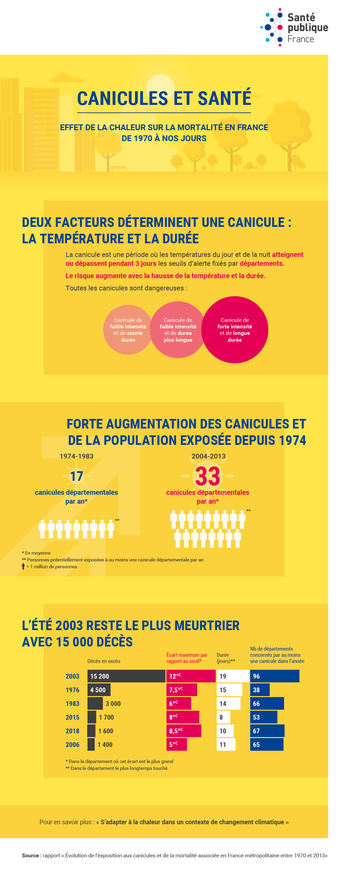
Climate Change and Heat Waves: Impact on Mortality from 1970 to the Present
A Significant Increase in Emergency Room Visits for Heat-Related Illnesses
During the summers of 2015 through 2024, more than 155,000 emergency department visits and more than 33,000 SOS Médecins consultations were recorded in the SurSaUD® emergency and death surveillance system for metropolitan France, as part of the composite indicator tracked under the heat wave health management system (iCanicule), which includes heatstroke or hyperthermia, dehydration, and hyponatremia.
The use of emergency care for the iCanicule indicator is observed throughout the summer, including outside of yellow, orange, or red heat wave alert periods: in recent years, up to 85% of emergency department visits and up to 80% of SOS-Médecins consultations have occurred outside of heat wave alert periods. However, peaks in emergency care use related to iCanicule are observed during periods when a large portion of the population is subject to a heat wave alert.
Reports from Previous Years
2025 Status Reports
Heat Waves and Health: Excess Mortality. Bulletin of September 11, 2025.
Heat Waves and Health in France. Bulletin dated August 20, 2025.
Heat Waves and Health in France. Bulletin of August 13, 2025.
Heat Waves and Health: Excess Mortality. Bulletin dated July 23, 2025.
Heat Waves and Health in France. Bulletin dated July 9, 2025.
Heat Waves and Health in France. Bulletin dated July 2, 2025.
Heat Waves and Health in France. Update as of June 25, 2025.
Status Updates 2024
Heat Waves and Health in France. Update as of August 21, 2024.
Heat Waves and Health in France. Update as of August 14, 2024.
Heat Waves and Health in France. Update as of August 7, 2024.
Heat Waves and Health in France. Update as of July 31, 2024.
2023 Updates
Heat Wave and Health Alert System. National Update as of August 30, 2023.
Heat Wave and Health Alert System. National Update as of August 22, 2023.
Heat Waves and Health: Excess Mortality. Update as of August 17, 2023.
Heat Wave and Health Alert System. National Update as of July 25, 2023.
Heat Waves and Health: Excess Mortality. Update as of August 1, 2023.
Heat Wave and Health Alert System. National Update as of July 18, 2023.
2022 Situation Updates
Heat Wave and Health Alert System. National Update as of August 16, 2022.
Heat Wave and Health Alert System. National Update as of August 9, 2022.
Heat Wave and Health Alert System. National Update as of August 2, 2022.
Heat Wave and Health Alert System. National Update as of July 26, 2022.
Heat Wave and Health Alert System. National Update as of July 19, 2022.
Heat Wave and Health Alert System. National Update as of June 28, 2022.
Heat Wave and Health Alert System. National Update as of June 21, 2022.
2021 Situation Reports
2020 Situation Reports
Public Health France Heat Wave Bulletin. Summer 2020 Summary.
Heat Wave and Health Alert System. National Update as of August 18, 2020.
Heat Wave and Health Alert System. National Update as of August 11, 2020.
Heat Wave and Health Alert System. National Update as of August 5, 2020.
2019 Situation Reports
Public Health France Heat Wave Bulletin. Summer 2019 Summary.
Heat Wave and Health Alert System. Mortality Report on the June and July 2019 Heat Waves.
Heat Wave and Health Alert System. National Update as of July 30, 2019.
Heat Wave and Health Alert System. National Update as of July 24, 2019.
Heat Wave and Health Alert System. National Update as of July 11, 2019.
Heat Wave and Health Alert System. National Update as of July 3, 2019.
Heat Wave and Health Alert System. National Update as of June 26, 2019.
Status Updates and 2018 Summary
Heat Wave and Health Alert System. Summary for July 24–August 8, 2018
Heat Wave and Health Alert System. National Update as of August 10, 2018.
Heat Wave and Health Alert System. National Update as of August 8, 2018.
Heat Wave and Health Alert System. National Update as of August 6, 2018.
Heat Wave and Health Alert System. National Update as of August 3, 2018.
Heat Wave and Health Alert System. National Update as of August 1, 2018.
Heat Wave and Health Alert System. National Update as of July 30, 2018.
Heat Wave and Health Alert System. National Update as of July 27, 2018.
Status Updates and 2017 Summary
Heat Wave and Health Alert System. National Update as of August 30, 2017.
Heat Wave and Health Alert System. National Update as of August 28, 2017.
Heat Wave and Health Alert System. National Update as of August 4, 2017.
Heat Wave and Health Alert System. National Update as of August 3, 2017.
Heat Wave and Health Alert System. National Update as of August 2, 2017.
Heat Wave from June 17 to 25, 2017. National Summary as of July 26, 2017.
Heat Wave and Health Alert System. National Update as of July 7, 2017.
Heat Wave and Health Alert System. National Update as of June 24, 2017.
Heat Wave and Health Alert System. National Update as of June 23, 2017.
Heat Wave and Health Alert System. National Update as of June 22, 2017.
Heat Wave and Health Alert System. National Update as of June 21, 2017.
Heat Wave and Health Alert System. National Update as of June 20, 2017.
Heat Wave and Health Alert System. National Update as of June 19, 2017.
Status Updates and 2016 Summary
Summary of health monitoring for the second heatwave episode from August 23 to 28, 2016.
Heat Wave and Health Alert System. National Update as of August 29, 2016.
Heat Wave and Health Alert System. National Update as of August 26, 2016.
Heat Wave and Health Alert System. National Update as of August 25, 2016.
Heat Wave and Health Alert System. National Update as of August 24, 2016.
Heat Wave and Health Alert System. National Update as of July 21, 2016.
Heat Wave and Health Alert System. National Update as of July 20, 2016.
Heat Wave and Health Alert System. National Update as of July 19, 2016.
Heat Wave and Health Alert System. National Update as of July 18, 2016
Archives
2015: Summary of heat waves that occurred in the summer of 2015. Epidemiological update as of October 9, 2015.
2014: Closure of the 2014 Heat Wave and Health Alert System
2012: Situation as of August 31, 2012
2011: Status as of August 31, 2011
2010: Status as of August 31, 2010
GEODES
Track heat wave trends over the years in France and in your region
In relation to

Climate change
thematic dossier
Climate change is rapidly and profoundly altering the environment. The health impacts of climate change are numerous and varied.

UV
thematic dossier
Ultraviolet radiation, which is everywhere, is emitted naturally by the sun or by artificial sources. It is responsible for various health conditions, including certain types of skin cancer.

Extreme cold
thematic dossier
Cold weather increases the risk of cardiovascular and respiratory conditions and can lead to hospitalizations and death. This impact is observed within 3 to 21 days of exposure to the cold.