



Cancers
Les cancers représentent en France la première cause de décès chez l’homme et la deuxième chez la femme. Santé Publique France copilote la surveillance épidémiologique et participe à leur prévention.
Common diseases with improving survival rates
Santé publique France, in partnership with the National Cancer Institute (INCa), the FRANCIM network of cancer registries, and the biostatistics and bioinformatics department of the Hospices Civils de Lyon (HCL), regularly publishes estimates of cancer incidence, mortality, and survival rates in France. This information helps guide, monitor, and evaluate cancer control policies.
In 2023, the total number of new cancer cases is estimated at 433,000, 57% of which are in men
This number has doubled since 1990.
Prostate cancer remains the most common cancer among men (59,800 new cases in 2018—estimate not available for 2023), followed by lung and colorectal cancers (33,000 and 26,000 new cases, respectively, in 2023).
Among women, breast cancer remains the most common (61,000 new cases in 2023). This is followed by colorectal and lung cancers (21,000 and 19,000, respectively).
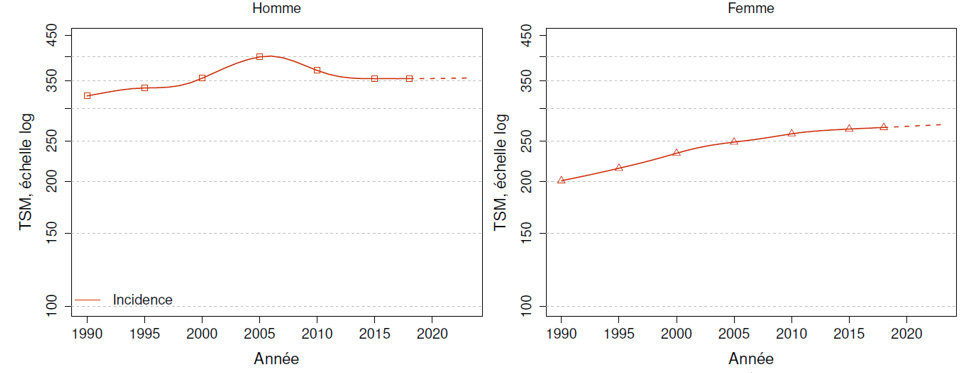
The trend in incidence (age-standardized rates based on the global population’s age structure) for all cancers between 1990 and 2023 differs by sex, reflecting that of the most common cancers in 2023: prostate cancer in men (one-quarter of male cancers in 2018), and breast and lung cancers in women (one-third and 9% of female cancers, respectively). Among men, the age-standardized incidence has thus increased only slightly, whereas it has continued to rise among women.
The study below covers the incidence of the 19 most common cancers (17 solid tumors and 2 hematologic malignancies) and all cancers. For incidence data on other cancer sites and cancer mortality, see the report on national estimates of cancer incidence and mortality in metropolitan France between 1990 and 2018.

article
30 June 2023
Incidence of the most common cancers in mainland France in 2023 and trends since 1990

rapport/synthèse
18 September 2019
National Estimates of Cancer Incidence and Mortality in Metropolitan France, 1990–2018 - Volume 1: Solid Tumors: A Study Based on Cancer Registries from the Francim Network
rapport/synthèse
18 September 2019
National Estimates of Cancer Incidence and Mortality in Metropolitan France, 1990–2018 - Volume 2: Malignant Blood Disorders: A Study Based on Cancer Registries from the Francim Network
Data from the report "National Estimates of Cancer Incidence and Mortality, 1990–2018"
Incidence rates for all cancers between 1990 and 2023 in mainland France, by year and sex (World Standardized Rate) – Logarithmic scale
The estimated total number of cancer deaths in 2018 was 157,000, 57% of which were among men
Lung cancer remains the leading cause of cancer deaths among men (23,000). This is followed by colorectal and prostate cancers (9,000 and 8,000, respectively).
Among women, three cancers account for the highest number of cancer deaths: breast (12,000), lung (10,000), and colorectal (8,000).
The trend in cancer mortality (standardized rate) between 1990 and 2018 shows a decline in both sexes, with a more pronounced decrease among men.
Globally, in 2018 [IARC 2018], it is estimated that:
18.1 million new cases and 9.6 million cancer deaths
That 1 in 8 men and 1 in 11 women die from this disease.
That 1 in 5 men and 1 in 6 women will develop cancer during their lifetime
Between 1989 and 2015, 5-year net survival improved only slightly for the high-risk cancers studied (central nervous system tumors in particular) or insufficiently in the context of rising incidence (lung, pancreas, etc.). The improvements observed are generally more pronounced among young adults than among older adults, except for ovarian cancer, where improvements are seen across all age groups.
Furthermore, cancers of the colon and rectum, cervix, breast, and prostate remain cancers with a good or even very good prognosis, with an estimated 5-year net survival rate of 63% for the first two, 88% for breast cancer, and 93% for prostate cancer among those diagnosed in 2010–2015.
Survival data by site are available for download at the bottom of the page.
Preventable cancers, modifiable risk factors
A number of cancers could be prevented: in 2015, it is estimated that in mainland France, approximately 41% of cancers among people over 30 were attributable to modifiable risk factors such as smoking, alcohol consumption, diet, overweight and obesity, certain infectious agents, certain occupational exposures, and exposure to natural and artificial ultraviolet radiation…
Downloadable publication
article
11 June 2019
Number and Proportion of Cancers Attributable to Lifestyle and Environmental Factors in Metropolitan France in 2015: Key Findings
Among men, the leading causes were tobacco and alcohol, which accounted for 29% and 8.5% of new cases of male cancers, respectively, followed by diet and certain occupational exposures, each accounting for 5.7% of new cases of male cancers.
Among women, the leading causes were tobacco, alcohol, overweight, and obesity, accounting for 9.3%, 7.5%, and 6.8% of new cases of female cancers, respectively.
Nevertheless, for a number of cancers, the risk factors are still under investigation.
Regional and departmental disparities of varying degrees
For the most common cancers (breast, prostate, colorectal), there are very few geographical differences in incidence. In contrast, the spatial distribution of mortality from these cancers is more heterogeneous, with excess mortality observed in the northern part of the country (breast and colorectal cancers in women) and in the northern and central parts (prostate and colorectal cancers in men).
The distribution of incidence, and especially of mortality for a number of cancers, reflects the well-known risk factors of smoking and alcohol consumption (lip-mouth-pharynx, esophagus, liver, larynx for both sexes, and lung in men).
There are significant geographical disparities for certain cancers: skin melanoma, central nervous system, thyroid, and multiple myeloma.
In the French Antilles (Guadeloupe and Martinique), there is an excess incidence and/or mortality for prostate, cervical, and stomach cancers, as well as multiple myeloma. Certain excesses are also found in French Guiana. Unlike in mainland France, stomach and uterine body cancers are among the most common cancers in the French West Indies, and cervical cancer is the second most common site of cancer among women in French Guiana.
For more information, consult the cancer incidence and mortality reports for each region.
View the overview of local and national surveillance using cancer registries.
Some definitions and facts to help you understand
What is cancer?
Cancer results from the uncontrolled multiplication of certain cells in the body. These cells first proliferate locally, then in the surrounding tissue, and finally spread to distant sites where they form metastases.
What is in situ cancer, infiltrating cancer, and invasive cancer?
Cancer in situ refers to an early-stage cancer when it is confined to the immediate area where it began and has not invaded adjacent tissues.
Infiltrating or invasive cancer refers to a cancer whose cells have invaded the tissues surrounding the tumor.
“Cancer”: A Generic Term for Different Diseases
The term “cancer” encompasses a wide range of conditions, grouping together a highly heterogeneous set of diseases—differing in their natural history, risk factors, diagnostic and therapeutic approaches, and prognosis.
Detecting Cancers in the Early Stages
Detecting cancer at an early stage significantly increases the chances of recovery.
Some cancers can be detected through simple tests. These tests help identify, within a population at moderate risk for cancer, individuals who have cancer but do not exhibit symptoms.
In France, national screening programs have been implemented for three types of cancer: breast (2004), colorectal (2008–2009), and cervical (2018–2019).
Cancer Control Policy
Since 2003, France has adopted an integrated approach to the fight against cancer through successive Cancer Plans:
The first Plan (2003–2007) helped structure the cancer care landscape and establish the National Cancer Institute (INCa), a dedicated agency with significant resources to address the full spectrum of cancer issues, from research to post-cancer care.
The 2009–2013 Cancer Plan emphasized personalized care and the deployment of therapeutic innovations.
The primary objective of the 2014–2019 Cancer Plan is to meet the needs and expectations of patients, their loved ones, and the general public. In particular, it established the right to be forgotten for patients.
A ten-year strategy to fight cancer will succeed these Plans.
Inequalities and Cancer
Epidemiological data document:
Regional inequalities within mainland France, as well as between mainland France and the overseas departments.
Social inequalities, particularly regarding prevention, access to screening, and delays in diagnosis.
Local and national surveillance
The benchmark: cancer registries
Since the 1970s, France has had general and specialized cancer registries that enable local and national epidemiological surveillance of cancers.
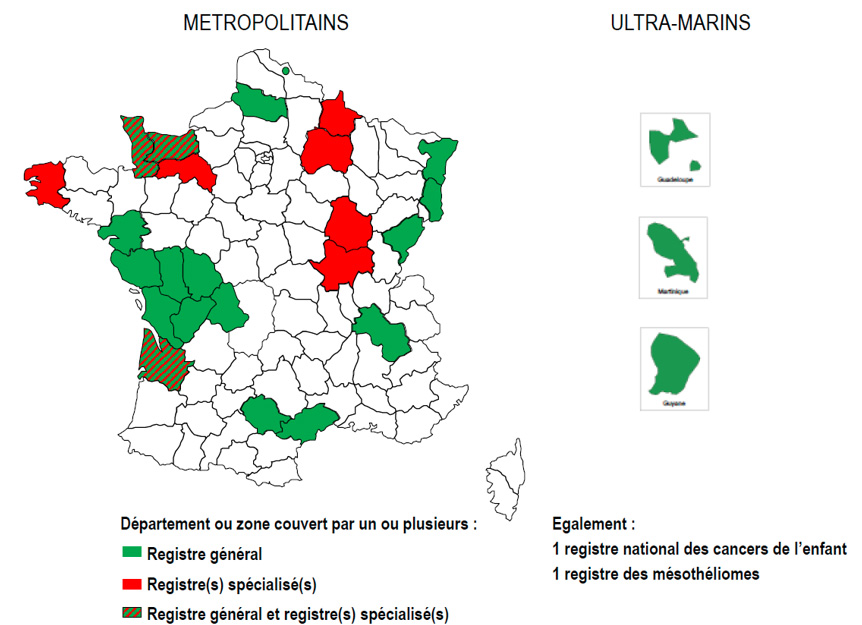
General cancer registries collect information on all cancers.
Specialized cancer registries collect extensive information on specific cancers (digestive system, malignant hematological diseases, breast and other gynecological cancers, central nervous system, thyroid, mesothelioma) or concerning specific populations (children and adolescents).
The FRANCIM network, created in 1997, brings together cancer registries evaluated by the Registry Evaluation Committee (CER). Its objectives are to harmonize methods for recording and coding cancers, to coordinate and publish the work carried out by cancer registries, to represent French cancer registries before the relevant health authorities, and to contribute to the development of collaborative research in public health and analytical epidemiology in the field of cancer.
Map of departments covered by a general or specialized cancer registry (mainland France: registries whose data are used for national cancer surveillance, July 2023)
A scientific and financial partnership for the epidemiological surveillance of cancer in France
In addition to the FRANCIM network of cancer registries, this partnership brings together:
the Biostatistics and Bioinformatics Department of the Hospices Civils de Lyon (HCL),
Santé publique France,
These four partners have defined a work program that provides for the regular production of key indicators for cancer surveillance in France and contributes to the development, monitoring, and evaluation of cancer control policies within the framework of national plans or strategies.
The data provided by the registries are supplemented by:
Medical-administrative data from the Program for the Medicalization of Information Systems (PMSI) and Long-Term Conditions (ALD)
Mortality data provided by the Center for Epidemiology on Medical Causes of Death (CépiDc, Inserm)
Existing prevention measures
Reduction of risk factors, in particular:
smoking, notably via the tabac-info-service.fr website
alcohol consumption, notably via the website alcool-info-service.fr,
persistent human papillomavirus (HPV) infection, which contributes to the development of cervical, anal, and certain oropharyngeal cancers; for cervical cancer, prevention relies not only on promoting HPV vaccination, notably via the vaccination-info-service.fr website, but also on screening.
but also on screening as well as other infections: hepatitis B and C viruses (liver cancer, certain malignant hematological diseases for the hepatitis C virus), the Helicobacter pylori bacterium (stomach cancer, certain malignant hematological diseases)
sedentary lifestyles and obesity, particularly through the mangerbouger.fr website
Cancer prevention addresses other risk factors, particularly those related to environmental and occupational exposures. These factors are the focus of specific programs within Santé publique France.
National Screening Program
These programs rely on numerous stakeholders, particularly departmental screening management structures and regional cancer screening coordination centers (CRCDC).
For breast cancer, a national organized screening program was launched nationwide in 2004 to detect breast cancer early and reduce mortality. All women aged 50 to 74 who have no symptoms or specific risk factors are invited to undergo an organized screening mammogram every two years at approved centers.
For colorectal cancer, a national organized screening program was launched nationwide in 2008–2009 to detect colorectal cancers early and reduce mortality. All individuals aged 50 to 74 who have no symptoms or specific risk factors are invited to undergo a fecal occult blood test every two years.
For cervical cancer, a national screening program was launched nationwide in 2018–2019 to detect precancerous lesions and treat them before they develop into cancer. This screening is recommended for women aged 25 to 65, including those vaccinated against HPV, as the vaccine does not protect against all HPV types linked to cervical cancer.
Key Strategic Issues
In a context of:
a growing and aging French population
of preventable cancers—through the reduction of risk factors, in particular
regional and departmental disparities that vary in severity depending on the type of cancer
national screening programs for the most common cancers (excluding lung cancer)
the main strategic priorities of Santé publique France are to:
preventing avoidable risk factors
develop studies on territorial and social health inequalities, particularly through studies on stage at diagnosis and the use of social deprivation indices
assessing the impact of cancer screening, particularly on mortality
developing surveillance of emerging topics (topographic cancer sub-sites, histological subtypes, risk of second cancers, etc.)
Data on all cancers
Cancer incidence and mortality
Nationally: estimates and trends
The study below covers the incidence of the 19 most common cancers (17 solid tumors and 2 hematologic malignancies) and all cancers. For incidence data on other cancer sites and cancer mortality, see the report on national estimates of cancer incidence and mortality in mainland France between 1990 and 2018.
Learn more: Incidence of the main cancers in metropolitan France in 2023 and trends since 1990
National Incidence, 1990–2023
National Incidence Data, 1990–2023
rapport/synthèse
18 September 2019
National Estimates of Cancer Incidence and Mortality in Metropolitan France, 1990–2018 - Volume 1: Solid Tumors: A Study Based on Cancer Registries from the Francim Network
rapport/synthèse
18 September 2019
National Estimates of Cancer Incidence and Mortality in Metropolitan France, 1990–2018 - Volume 2: Malignant Blood Disorders: A Study Based on Cancer Registries from the Francim Network
Data from the report "National Estimates of Cancer Incidence and Mortality, 1990–2018"
At the regional and departmental levels
Incidence and mortality estimates in mainland France and the overseas departments and regions
Observed incidence and trends over time in the departments covered by the Francim network registries (mainland France and overseas departments and regions)
Among adolescents and young adults (ages 15–39)
Survival of people with cancer
At the national level: estimates and trends
Data from mainland France
Solid tumors
Malignant hematological diseases
Non-Hodgkin lymphomas – No fact sheet for this level of HM
Lymphoplasmacytic lymphoma / Waldenström's macroglobulinemia
Precursor cell lymphoblastic leukemia/lymphoma (B, T, or unclassified)
Chronic myeloproliferative syndromes (CMS) – No fact sheet for this level of HM
Data from the Overseas Departments and Regions
Survival rates for people with cancer were estimated for 10 common cancers of regional interest, based on data from the general cancer registries of Guadeloupe, Martinique, and Réunion, among individuals diagnosed between 2008 and 2015, using the same method as in mainland France.
Overall, the 5-year net standardized survival rate in the three overseas departments and regions is lower than that of mainland France, though there are differences depending on the cancer site and the specific region. The 5-year age-standardized net survival rate is similar across the three DROMs and mainland France for stomach cancer (30%) and cervical cancer (63%). In Martinique, the 5-year age-standardized net survival rate for prostate cancer (95%) is higher than that of mainland France (93%).
Specific information: conditional net survival
Stage at diagnosis
Breast, colon, and rectal cancers, mainland France
Learn more
rapport/synthèse
6 September 2019
Current Status of Diagnosis for Breast, Colon, and Rectal Cancers: A Study Based on Cancer Registries from the Francim Network
Colonna M, et al. Time trends and short-term projections of cancer prevalence in France. Cancer Epidemiology 56, 2018, 97–105
Evaluation of the performance of the national organized breast cancer screening program
Evaluation of the performance of the national organized colorectal cancer screening program
Evaluation of the performance of the national cervical cancer screening program

Breast cancer
thematic dossier
Breast cancer is the most common form of cancer in France and is the leading cause of cancer-related deaths among women. It is covered by a national screening program designed to detect the...

Cervical cancer
thematic dossier
Cervical cancer, which is caused in nearly 100% of cases by a sexually transmitted human papillomavirus infection, can be prevented through HPV vaccination and screening.

Colorectal cancer
thematic dossier
Find the latest news and key information about colorectal cancer here.

Mesotheliomas
thematic dossier
Mesothelioma is a type of cancer for which asbestos is the only known risk factor. Its incidence is on the rise, particularly among women. It qualifies for medical and social benefits.

Skin cancers
thematic dossier
Skin cancer may be the most common form of cancer in France. Caused in more than 85% of cases by excessive exposure to natural or artificial ultraviolet (UV) radiation, it can be prevented by...
Our latest news

news
Call for Nominations for the Renewal of the Scientific Advisory Board of the...

news
Growing Up with Screens. A special report in *La Santé en action* No. 474,...

news